Price
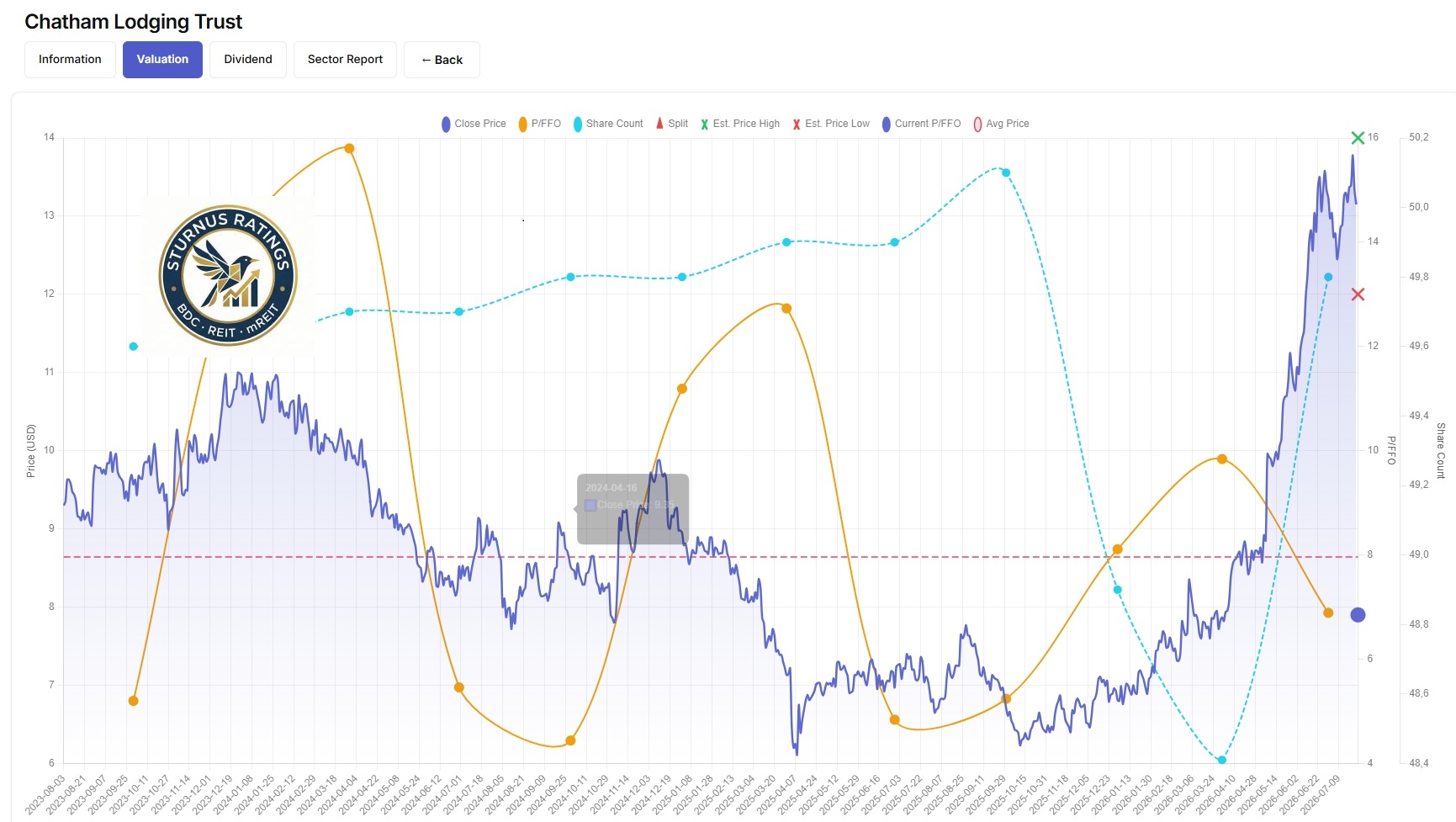
Chatham Lodging Trust has experienced a major re-rating in 2026. MarketWatch data available before the Q2 earnings release showed the shares up approximately 52% over three months and 96% year-to-date, with a roughly 100% one-year gain. The stock was also trading near its highest levels in several years. This is a dramatic change from the valuation environment in which the company traded during 2024-2025. The most important point is that the share-price appreciation has been accompanied by real fundamental improvement rather than being purely speculative:
- Q1 2026 AFFO per diluted share increased 18% YoY to $0.20.
- Portfolio RevPAR increased 1% to $128.
- Occupancy increased to 73%.
- ADR increased to $177, an all-time Q1 record.
- Hotel EBITDA margin increased to 32% from 30%.
- The company completed a $92 million acquisition of six hotels.
- Management increased 2026 guidance by approximately 15% after Q1.
- Chatham continued its share-repurchase program.
This combination explains why the market has re-rated the stock. However, the magnitude of the rally has also materially changed the investment equation. Investors who bought Chatham Lodging Trust at depressed valuations in 2024 or 2025 potentially benefited from both fundamental recovery and multiple expansion. A new investor today is paying considerably more for those same assets.
Relative performance versus lodging REIT peers
Chatham Lodging Trust's recent performance has been considerably stronger than many larger lodging REITs. The market has increasingly viewed Chatham as a small-cap lodging recovery and value story, rather than simply another hotel REIT. Its smaller size is both an advantage and a disadvantage. The advantage is that a relatively small acquisition or asset sale can materially affect per-share results. The $92 million six-hotel acquisition is significant relative to Chatham's existing portfolio and has the potential to accelerate AFFO growth. The disadvantage is that Chatham has less geographic and financial diversification than larger lodging REITs such as Apple Hospitality REIT, Inc., Host Hotels & Resorts, Inc. or Ryman Hospitality Properties, Inc.. The stock's recent outperformance therefore reflects both improving fundamentals and a higher risk appetite toward small-cap lodging equities.
Key catalysts affecting the share price - Q2 2026 results
This is now the most important near-term catalyst.
The market will be looking for:
- RevPAR growth;
- occupancy trends;
- ADR growth;
- hotel EBITDA margins;
- performance of the six newly acquired hotels;
- Silicon Valley performance;
- Los Angeles stabilization;
- acquisition integration;
- AFFO per share;
- leverage after the acquisition;
- and, most importantly, whether full-year 2026 guidance is maintained or increased.
Given the approximately 96% YTD appreciation reported by MarketWatch, the market is now likely to demand continued execution, not merely stable results.
2. Silicon Valley recovery
Silicon Valley is particularly important. It represented approximately 17% of trailing-12-month hotel EBITDA, and Q1 RevPAR increased 11%, while the comparable portfolio excluding the Mountain View renovation showed much stronger performance. Management said RevPAR excluding renovation impacts was up approximately 23% in the market. If technology-sector business travel continues to recover, this could be a meaningful earnings catalyst.
3. Accretive acquisitions
The six-hotel acquisition for $92 million was completed at approximately $156,000 per room. Management reported that the acquired portfolio's RevPAR increased approximately 6% in Q1. If Chatham can continue purchasing hotels at attractive valuations while maintaining low leverage, acquisition-led AFFO growth could be significant.
4. Share repurchases
Chatham repurchased approximately 2.2 million shares at an average price of $7.04 through Q1 2026, representing approximately $15.6 million of cumulative purchases under its $25 million authorization. This is highly accretive when shares trade below intrinsic value. The problem for new investors is that the stock has appreciated substantially since those repurchases. The future value of additional buybacks depends heavily on whether management can continue buying below NAV or below the intrinsic value of the hotel portfolio.
Technical and fundamental sentiment
The technical picture is clearly bullish after the enormous 2026 rally. The fundamental picture is also positive, but less unequivocally so. Q1 results were good. RevPAR was positive, margins expanded, AFFO per share grew 18%, leverage remained low and management raised guidance. But a stock that has approximately doubled year-to-date requires increasingly strong results to justify further multiple expansion.
Price assessment: Positive fundamentals, but significantly less attractive risk/reward after the 2026 re-rating.
Dividend
Chatham Lodging Trust increased its quarterly common dividend by 11% to $0.10 per share in March 2026. This implies an annualized dividend of $0.40 per share.
The dividend was previously:
- 2023: $0.28 annually
- 2024: $0.28 annually
- 2025: $0.36 annually
- 2026 current annualized rate: $0.40
The progression from $0.28 in 2024 to $0.36 in 2025 represented a 28.6% increase, followed by another 11.1% increase in 2026. However, the current yield is much lower than it would have been at the depressed prices of previous years. If the stock is valued around $13-$14, the $0.40 annual dividend represents a yield of approximately 2.9%-3.1%. This is an important change in the investment profile. Chatham Lodging Trust was historically much more attractive as a high-yield recovery REIT. At the current valuation, it increasingly resembles a growth-oriented lodging REIT with a modest dividend.
AFFO payout ratio
Q1 2026 AFFO per diluted share was $0.20, while the quarterly dividend was $0.10. That implies a quarterly AFFO payout ratio of approximately: $0.10 ÷ $0.20 = 50%
This is excellent coverage on a quarterly basis. However, investors should not simply annualize Q1 AFFO because hotel REITs are highly seasonal. Q1 is generally weaker than the spring and summer travel periods.
Management's original 2026 guidance was:
- AFFO: $53-$58 million
- AFFO per diluted share: $1.04-$1.14
- Weighted-average shares/units: approximately 50.9 million
At the current $0.40 annual dividend, the implied full-year AFFO payout ratio is approximately:
- 38.5% at $1.04 AFFO
- 35.1% at $1.14 AFFO
This is an exceptionally conservative payout ratio.
Dividend safety
I consider the common dividend well covered by AFFO.
The strongest evidence is the combination of:
- 2026 AFFO guidance of $1.04-$1.14 per share;
- $0.40 annualized dividend;
- approximately 35%-39% implied AFFO payout ratio;
- Q1 AFFO growth of 18%;
- low leverage of approximately 25% net debt to hotel investments at cost;
- substantial revolver capacity.
This gives Chatham a considerable buffer before the dividend would become financially stressed.
But there is an important caveat
The dividend is safe today, but hotel REIT dividends are inherently less defensive than those of high-quality net-lease or shopping-center REITs.
Hotels have:
- daily pricing;
- no long-term contractual rent protection;
- significant economic sensitivity;
- high operating leverage;
- substantial recurring capital expenditure requirements;
- exposure to business travel and tourism;
- exposure to labor and insurance costs.
Chatham itself identifies economic downturns, oversupply, competition, inflation, interest rates, travel disruptions and required capital reinvestment as risks that can affect its ability to make distributions.
Therefore, I would rate the dividend: Current safety: High
Long-term safety: Moderately high
Dividend growth potential: Moderate to high
Recession resilience: Moderate
The low payout ratio is a major advantage.
Valuation
Chatham Lodging Trust's 2026 guidance is more useful for valuation than GAAP earnings because the company expects a GAAP net loss.
Management's 2026 guidance:
- AFFO per share: $1.04-$1.14
- AFFO: $53-$58 million
- Adjusted EBITDA: $84-$89 million.
Using a share price of approximately $13-$14: Price / 2026 AFFO
At $13:
- $13 / $1.14 = 11.4x
- $13 / $1.04 = 12.5x
At $14:
- $14 / $1.14 = 12.3x
- $14 / $1.04 = 13.5x
Therefore, at approximately $13-$14, Chatham trades at roughly 11.4x-13.5x forward AFFO, depending on the exact share price and whether the low or high end of guidance is achieved. That is not expensive in absolute terms. However, the stock's 2026 rally has compressed the valuation discount substantially.
AFFO growth matters
The critical question is whether 2026 guidance is conservative. Management initially projected: $1.04-$1.14 AFFO per share
and then increased guidance by approximately 15% after Q1, citing strong operating performance, the acquisition and share repurchases. That is a significant positive signal. If Chatham eventually produces AFFO materially above $1.14 per share, the current valuation becomes more attractive. If $1.04-$1.14 proves to be close to normalized earnings power, then the stock is no longer obviously cheap after the 2026 rally.
Comparison with peers
Chatham Lodging Trust should not be valued exactly like the largest lodging REITs.
Its advantages include:
- lower leverage;
- smaller and more focused portfolio;
- meaningful exposure to extended-stay hotels;
- significant exposure to corporate demand;
- potential for outsized per-share growth from acquisitions;
- aggressive capital recycling.
Its disadvantages include:
- smaller scale;
- less diversification;
- higher sensitivity to individual markets;
- greater dependence on management's capital allocation decisions;
- smaller liquidity and trading volume;
- greater volatility.
The appropriate valuation should therefore probably sit below the highest-quality large lodging REITs, but the discount should not be excessive if Chatham continues to deliver strong AFFO growth and maintain its conservative leverage. The stock's current valuation is no longer the obvious distressed value opportunity it was previously.
NAV considerations
NAV is particularly important for Chatham Lodging Trust.
The company owns physical hotel assets whose values are influenced by:
- hotel EBITDA;
- capitalization rates;
- RevPAR growth;
- location quality;
- franchise affiliation;
- remaining useful life;
- renovation requirements;
- and replacement cost.
The company demonstrated its ability to monetize assets by selling four older hotels for approximately $71 million, or approximately $90 million including near-term avoided renovation expenditures, at an approximate 6% capitalization rate. Management used proceeds to reduce debt and repurchase shares. This provides an important market-based indication of asset values. The 2026 acquisition of six hotels for $92 million, or approximately $156,000 per room, provides another reference point for the valuation of hotel assets. If yes, the company can create substantial NAV and AFFO growth. If acquisition cap rates compress while interest rates remain elevated, the economics become much less attractive.
My NAV assessment
I would view Chatham's NAV as potentially higher than the current market capitalization, but I would not assign a precise NAV premium without a property-by-property appraisal using current hotel cap rates and updated Q2 2026 operating data. The company's 6% disposition cap rate is encouraging, but one should not automatically apply a 6% cap rate to the entire portfolio. Older hotels, weaker markets and properties requiring renovation could warrant materially higher capitalization rates.
Balance sheet, leverage and debt profile
This is one of Chatham Lodging Trust's greatest strengths.
At March 31, 2026:
- Total debt: approximately $428 million
- Average interest rate: 5.8%
- Fixed-rate mortgage debt: $143 million at 7.2%
- Term loan: $200 million at 5.1%
- Revolver: $85 million at 5.2%
- Net debt / hotel investments at cost: approximately 25%.
A leverage ratio of approximately 25% is conservative for the hotel REIT sector. This is particularly valuable because hotels are cyclical. A hotel REIT with 40%-50% leverage can face significant problems during a downturn, whereas Chatham has more balance-sheet capacity to absorb weaker RevPAR. The $300 million revolving credit facility also provides meaningful liquidity, although the company had already drawn $85 million at the end of Q1, partly reflecting the acquisition activity. The principal concern is the variable-rate exposure. The term loan and revolver are floating-rate or otherwise rate-sensitive, meaning that the Federal Reserve's policy path directly affects Chatham's interest expense.
This creates a trade-off: Low leverage = strong balance-sheet protection
but
Floating-rate debt = meaningful sensitivity to interest rates
The overall balance-sheet risk remains moderate-to-low, in my assessment.
Interest rates and macroeconomic conditions
The hotel sector is more economically sensitive than most REIT subsectors.
A strong economy benefits Chatham through:
- business travel;
- corporate meetings;
- leisure demand;
- higher ADR;
- stronger occupancy;
- increased RevPAR.
A recession can quickly reverse those trends. The current environment is mixed. The Federal Reserve's policy stance remains restrictive relative to the pre-pandemic period, while inflation remains above target. This creates pressure through financing costs and potentially limits valuation multiples for REITs. At the same time, continued economic growth and corporate activity are positive for hotel demand. For Chatham, a decline in short-term interest rates would likely be particularly beneficial because of its floating-rate borrowings. It could also improve acquisition economics and potentially increase the valuation investors assign to hotel REITs. That scenario would pressure both AFFO and valuation simultaneously.
Is Chatham Lodging Trust undervalued?
My valuation conclusion is: At approximately $13-$14: Fairly valued to moderately undervalued
I would not call the shares deeply undervalued after the 2026 rally.
However, I also would not classify them as expensive if:
- management achieves the upper end of 2026 AFFO guidance;
- RevPAR growth accelerates;
- the acquisition produces expected synergies;
- leverage remains near 25%;
- and the company continues to repurchase shares below NAV.
The strongest argument for further upside is that Chatham's 2026 AFFO guidance may still be conservative. Management already increased guidance by approximately 15% after Q1, and the company has several potential growth drivers. The strongest argument against further upside is that the market has already anticipated much of this improvement. A stock that has risen roughly 96% YTD requires increasingly strong results to continue rerating.
Conclusion
1. Strong balance sheet
Approximately 25% net debt to hotel investments at cost is conservative for a lodging REIT. This gives Chatham considerable financial flexibility and reduces bankruptcy/refinancing risk during a downturn.
2. Excellent dividend coverage
The $0.40 annualized dividend is covered by projected 2026 AFFO of $1.04-$1.14 per share at an implied payout ratio of approximately 35%-39%. That is a substantial margin of safety.
3. Improving operating performance
Q1 2026 AFFO per share increased 18%, hotel EBITDA margins expanded, occupancy improved and ADR reached a record first-quarter level.
4. Attractive acquisition strategy
The six-hotel $92 million acquisition expands the portfolio and diversifies Chatham geographically into markets benefiting from manufacturing and distribution investment.
5. Significant capital allocation flexibility
Management has demonstrated willingness to sell older assets, repay debt, repurchase shares and selectively acquire hotels.
6. Potential for further AFFO growth
The combination of acquisitions, operating improvement, share repurchases and potentially lower interest rates provides several avenues for per-share AFFO growth.
Key risks
1. The stock has already rerated dramatically
The approximately 96% YTD gain means that the market is no longer pricing Chatham as a distressed or deeply discounted lodging REIT.
2. Hotel cyclicality
Chatham's earnings are exposed to economic downturns, business travel, tourism and consumer spending.
3. Floating-rate debt
Interest rates directly affect the company's financing costs. The $200 million term loan and $85 million revolver exposure make the company more rate-sensitive than a REIT with predominantly fixed-rate debt.
4. Geographic concentration
Silicon Valley is a major EBITDA contributor. Its recovery is a significant positive, but concentration also increases risk if the technology sector or local business travel weakens.
5. Capital expenditure requirements
Hotels require ongoing renovations and property upgrades. AFFO must therefore be evaluated carefully because reported FFO can overstate the cash available for distribution if recurring capital expenditures are not adequately considered.
6. Execution risk
The acquisition strategy can generate substantial value, but only if Chatham acquires properties at attractive prices and successfully integrates and renovates them.
Near-term outlook
The next major catalyst is the Q2 2026 earnings release.
I would pay particular attention to whether:
- RevPAR growth accelerates above the 2026 guidance range;
- Silicon Valley continues its strong recovery;
- the new six-hotel portfolio delivers expected growth;
- hotel EBITDA margins remain above 33%;
- AFFO exceeds expectations;
- leverage remains comfortably below 30%;
- and management raises 2026 guidance again.
If management raises guidance again, the current valuation could still be justified. If guidance is maintained but operating trends remain strong, I would expect the shares to consolidate rather than necessarily continue their previous pace of appreciation. If management cuts guidance, the stock could experience a significant correction because the market has already priced in a considerable amount of recovery.
Long-term outlook
I am constructive on the company but more cautious on the stock price than I was before the 2026 rally. This is a fundamentally attractive strategy. The company also has an important advantage: its balance sheet gives management more strategic flexibility than many highly leveraged hotel REITs. The major question is whether Chatham can continue to generate double-digit AFFO-per-share growth after the acquisition and share repurchase benefits begin to normalize. If it can, the current valuation could still prove reasonable. If AFFO growth settles into low-single digits, the recent share-price appreciation has probably brought the stock close to fair value.
Investment thesis
Chatham Lodging Trust is fundamentally attractive, but the investment case has shifted from "deep value recovery" toward "growth at a reasonable valuation."
The business fundamentals are improving:
- RevPAR is recovering;
- margins are expanding;
- AFFO per share is growing;
- acquisitions are accretive;
- leverage is conservative;
- and the dividend is exceptionally well covered.
The balance sheet is arguably the company's strongest defensive feature, while the acquisition and capital-recycling strategy is its largest potential source of long-term upside. The major issue is valuation after the enormous 2026 rally. The market has already recognized much of the company's improvement, so future returns will depend increasingly on actual AFFO growth rather than further valuation expansion.
I would currently view Chatham Lodging Trust as a HOLD / selective BUY rather than a strong BUY at the post-rally valuation. For an investor who already owns the shares at a much lower cost basis, I see no fundamental reason to sell solely because of the price increase: the balance sheet is healthy, AFFO coverage is strong and management is executing well. For a new investor, however, I would be more selective. The ideal setup would be either a pullback in the share price or another material increase in AFFO guidance that demonstrates the company's intrinsic earnings power is rising faster than the market valuation. The most important question for the next 12-18 months is therefore not whether Chatham Lodging Trust can grow - it appears capable of doing so - but whether AFFO growth can keep pace with the roughly 2026 doubling of the share price. If management can continue delivering double-digit per-share AFFO growth while keeping leverage around 25%, I believe the stock can justify a premium to historical valuations. If growth normalizes sharply, the current price leaves considerably less margin of safety than it did at the beginning of 2026.
Comments (0)
Log in to leave a comment.
No comments yet. Be the first to comment!