Price
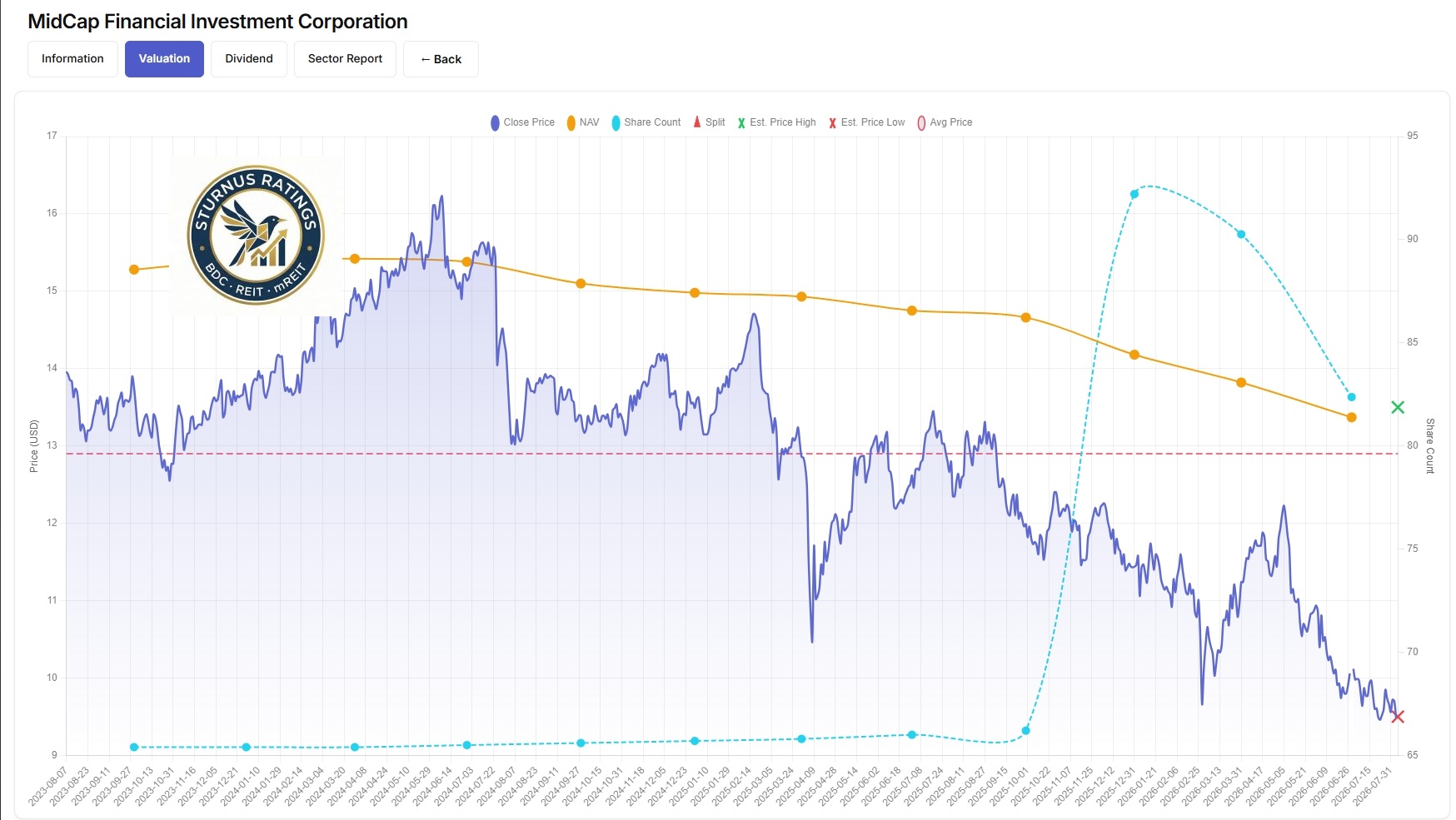
MidCap Financial Investment Corporation's shares have remained under pressure throughout 2026 despite generally stable operating performance. Investor sentiment continues to reflect concerns surrounding lower short-term interest rates, pressure on recurring Net Investment Income ("NII"), and the credit outlook for middle-market borrowers. Unlike many higher-quality BDCs that trade near or above NAV, MFIC continues to trade at a meaningful discount despite management's aggressive share repurchase program.
Share price performance relative to NAV
The most important observation is that the share price has materially underperformed NAV. While NAV has declined from 2025 levels due primarily to valuation marks on several legacy investments, the decline in market price has been significantly larger. Management continues to emphasize that recent credit performance has been more resilient than the market implies and has been actively repurchasing stock because it believes the discount is excessive.
Price-to-NAV (P/NAV)
Following the Q2 2026 report, MFIC reported a NAV per share that remained well above the current market price (approximately the high-$13/share range versus a market price around $10, depending on the trading day). The stock therefore trades at roughly: P/NAV: approximately 0.72–0.75x
This represents one of the widest discounts among larger publicly traded BDCs.
For comparison:
- Ares Capital Corporation: ~1.00–1.10x NAV
- Sixth Street Specialty Lending, Inc.: ~0.95–1.05x NAV
- Barings BDC, Inc.: ~0.75–0.80x NAV
- Oaktree Specialty Lending Corporation: ~0.80–0.90x NAV
- MidCap Financial Investment Corporation: ~0.72–0.75x NAV
MFIC currently trades closer to distressed-credit valuations despite portfolio fundamentals that are materially stronger than those of many lower-quality peers.
Historical valuation
Historically, MFIC typically traded between approximately 0.85x and 1.0x NAV. Today's valuation therefore remains well below its long-term average.
Market sentiment
Investors remain concerned about:
- declining base interest rates,
- pressure on floating-rate loan yields,
- prior portfolio markdowns,
- legacy investments originated during 2021–2022,
- externally managed structure.
Conversely, investors have reacted positively to management's aggressive repurchase program, which is highly accretive at current valuation levels.
Key catalysts
Positive catalysts
- continued share repurchases
- stable NAV
- improving credit metrics
- eventual recovery in private credit valuations
- stabilization of NII
Negative catalysts
- additional Fed rate cuts
- rising non-accruals
- further unrealized losses
- recession-driven credit deterioration
Dividend
Following the dividend reduction announced earlier this year, MFIC currently pays a quarterly dividend consistent with management's revised long-term earnings outlook. Management stated that the cut reflected expectations for lower earnings power as base rates normalize rather than immediate portfolio stress. Current dividend yield remains among the highest within the BDC universe.
Dividend history
MFIC had maintained a higher distribution for several years before reducing the quarterly dividend to better align with expected recurring earnings. While dividend cuts are generally viewed negatively, the adjustment substantially improved coverage.
NII coverage
Q2 results indicate recurring NII continues to cover the revised dividend with a reasonable margin. Coverage has improved materially versus the period immediately preceding the dividend reduction. Unlike several higher-yield BDCs, MFIC no longer appears to be over-distributing.
Payout ratio
The payout ratio now appears conservative compared with prior quarters.
This provides:
- better retained earnings
- greater balance sheet flexibility
- improved NAV protection
Spillover income
MFIC continues to maintain undistributed taxable income, although not at the exceptionally high levels seen at peers such as Sixth Street Specialty Lending, Inc. or Ares Capital Corporation. Spillover income remains supportive but is no longer a primary driver of future distributions.
Dividend sustainability
Current dividend appears:
Well covered
Future increases are unlikely until:
- Fed policy stabilizes
- recurring earnings recover
- portfolio yields stabilize
Management has clearly prioritized dividend sustainability over maximizing current yield.
Management outlook
Management expects earnings to remain pressured by lower base rates but believes the revised dividend level appropriately reflects normalized earnings power.
Valuation
NAV trend
NAV has declined modestly over the past year due primarily to:
- unrealized marks
- several older portfolio investments
- credit-specific issues
Importantly, the decline has not been broad-based across the portfolio. Management specifically identified several legacy investments as the primary source of recent NAV pressure.
NII trend
Recurring NII remains relatively stable despite declining benchmark rates. However, earnings are no longer benefiting from the exceptionally high SOFR environment experienced during 2023–2024.
Future earnings will increasingly depend upon:
- new loan origination spreads
- credit quality
- funding costs
- portfolio growth
Portfolio quality
MFIC maintains a predominantly senior secured lending strategy.
The portfolio continues to be heavily weighted toward:
- first-lien loans
- sponsor-backed borrowers
- diversified industries
Credit quality remains acceptable despite isolated problem credits.
Non-accruals
Non-accruals remain elevated versus best-in-class BDCs but remain manageable. There is currently no evidence of widespread portfolio deterioration. The primary issues remain concentrated within several older investments rather than reflecting systemic weakness.
Portfolio diversification
Diversification remains one of MFIC's strengths.
The company benefits from:
- hundreds of portfolio companies
- broad industry diversification
- predominantly sponsor-backed lending
- strong affiliation with Apollo's private credit platform
Leverage
Leverage remains appropriate for the portfolio profile. Management has not materially increased leverage despite wider spreads. The balance sheet retains adequate flexibility.
Liquidity
Liquidity remains strong. Debt maturities appear well laddered, limiting refinancing risk over the near term.
The company maintains access to:
- revolving credit facilities
- unsecured debt markets
- institutional funding
Federal Reserve impact
MFIC is moderately sensitive to declining short-term rates.
Since most investments are floating rate:
- asset yields decline relatively quickly,
- while funding costs decline with some lag.
Consequently, additional Fed easing is likely to modestly pressure NII over the coming quarters.
Relative valuation
Investment Corporation~0.72–0.75x. MFIC screens as one of the cheapest large BDCs.The valuation discount appears considerably larger than would be justified solely by current portfolio fundamentals.
Conclusion
Strengths
- Attractive discount to NAV
- High recurring dividend yield
- Well-covered dividend following reset
- Diversified first-lien portfolio
- Strong Apollo credit platform
- Aggressive and highly accretive share repurchases
- Adequate liquidity
- Reasonable leverage
Risks
- Lower Fed rates reducing NII
- Legacy credit issues
- Continued NAV pressure from older investments
- External management structure
- Potential deterioration in private credit markets during recession
Outlook for NAV
NAV should stabilize provided:
- credit losses remain contained,
- valuation marks improve,
- legacy problem investments continue to resolve.
The pace of decline appears significantly slower than during late 2025.
Outlook for NII
NII is likely to gradually trend lower as floating-rate assets continue to reprice. However, management has already adjusted the dividend to reflect this lower earnings environment.
Dividend outlook
The dividend now appears sustainable. Near-term increases seem unlikely, but another reduction also appears unnecessary unless credit conditions deteriorate materially.
Credit outlook
Portfolio quality remains acceptable. Current issues appear concentrated rather than systemic. The portfolio continues to be supported by strong sponsor-backed lending relationships and conservative first-lien positioning.
Federal Reserve outlook
Further rate cuts remain the largest earnings headwind. Conversely, eventual stabilization of policy rates would likely stabilize NII and improve investor confidence in the sector.
Investment thesis
MidCap Financial Investment Corporation currently represents a classic value opportunity within the BDC sector. The stock trades at one of the deepest discounts to NAV among large, diversified BDCs despite maintaining a predominantly first-lien portfolio, reasonable leverage, and a dividend that appears appropriately sized following its reset. Management has strengthened shareholder value through aggressive share repurchases at a substantial discount to NAV, creating immediate NAV accretion. While lower interest rates and legacy credit issues continue to weigh on earnings expectations, much of this risk already appears reflected in the current valuation. Assuming credit performance remains stable and management continues executing its capital allocation strategy, MFIC offers meaningful upside potential through a combination of discount narrowing and a double-digit dividend yield, making the shares appear undervalued relative to their long-term intrinsic value and comparable BDC peers.
Comments (0)
Log in to leave a comment.
No comments yet. Be the first to comment!