Price
Americold Realty Trust, Inc. has materially underperformed the broader REIT sector over the past several years. While many industrial REITs have recovered from the 2022–2023 interest rate shock, Americold has struggled with slower earnings growth, customer inventory normalization, and elevated financing costs.
However, during 2026 investor sentiment has gradually improved as:
- warehouse utilization stabilized,
- customer inventories began recovering,
- management continued improving operating efficiency,
- AFFO growth resumed after several difficult years.
Despite this recovery, shares continue trading well below their historical highs. Americold trades at a noticeable valuation discount to traditional industrial REITs, reflecting its lower growth profile and more operationally intensive business model.
Key Catalysts
Improving Warehouse Economics
Second-quarter results indicated continued operational stabilization after two years of customer inventory reductions.
Management highlighted:
- improving throughput,
- stronger warehouse utilization,
- continued pricing discipline,
- higher economic occupancy.
These factors should support further EBITDA growth over the coming quarters.
Supply Chain Normalization
Food manufacturers and grocery distributors continue rebuilding inventories following post-pandemic destocking.
Cold storage demand remains supported by:
- growing frozen food consumption,
- pharmaceutical logistics,
- food export growth,
- increasing outsourcing by food producers.
Unlike traditional warehouse REITs, Americold benefits from structural growth in temperature-controlled logistics.
Operational Efficiency
Management continues implementing productivity initiatives including:
- warehouse automation,
- robotics,
- energy efficiency investments,
- transportation optimization.
These initiatives should gradually improve operating margins.
Market Sentiment
Investor sentiment has improved but remains cautious.
Positive drivers include:
- recovering earnings,
- improving occupancy,
- better cost control.
Negative factors include:
- slower AFFO growth than industrial peers,
- relatively high leverage,
- significant capital requirements.
Dividend
Americold currently pays a quarterly dividend of approximately $0.23 per share, or $0.92 annually. Based on the recent share price, the dividend yield is approximately 4.0–4.5%. While attractive relative to the S&P 500, the yield remains below many net lease REITs because Americold retains capital to fund growth investments.
Dividend History
Dividend growth has been modest.
Since becoming a public REIT, Americold has generally prioritized:
- balance sheet improvement,
- acquisitions,
- warehouse development,
- technology investments,
rather than aggressive dividend increases. Unlike Realty Income Corporation or NNN REIT, dividend growth has been relatively limited.
AFFO Coverage
Second-quarter AFFO continued improving as operating conditions normalized. The dividend appears comfortably covered by AFFO.
Estimated AFFO payout ratio:
approximately 60–65%
This provides flexibility for:
- capital expenditures,
- debt reduction,
- future dividend growth.
Dividend Safety
Dividend safety appears strong.
Supporting factors include:
- stable contractual warehouse revenue,
- diversified customer base,
- improving operating cash flow,
- conservative payout ratio.
Unlike hotel REITs, warehouse utilization tends to be considerably more stable during economic slowdowns.
Dividend Risks
Potential risks include:
- food inventory reductions,
- slower warehouse throughput,
- customer bankruptcies,
- elevated interest expense,
- slower development returns.
However, food logistics remain one of the more defensive industrial real estate sectors.
Valuation
Q2 Operating Performance
Americold delivered a constructive second quarter characterized by:
- improving warehouse occupancy,
- higher same-store NOI,
- AFFO growth,
- expanding EBITDA,
- stable customer retention.
Management reaffirmed that operational performance continues improving following the inventory correction experienced during 2023–2025.
Price-to-FFO and Price-to-AFFO
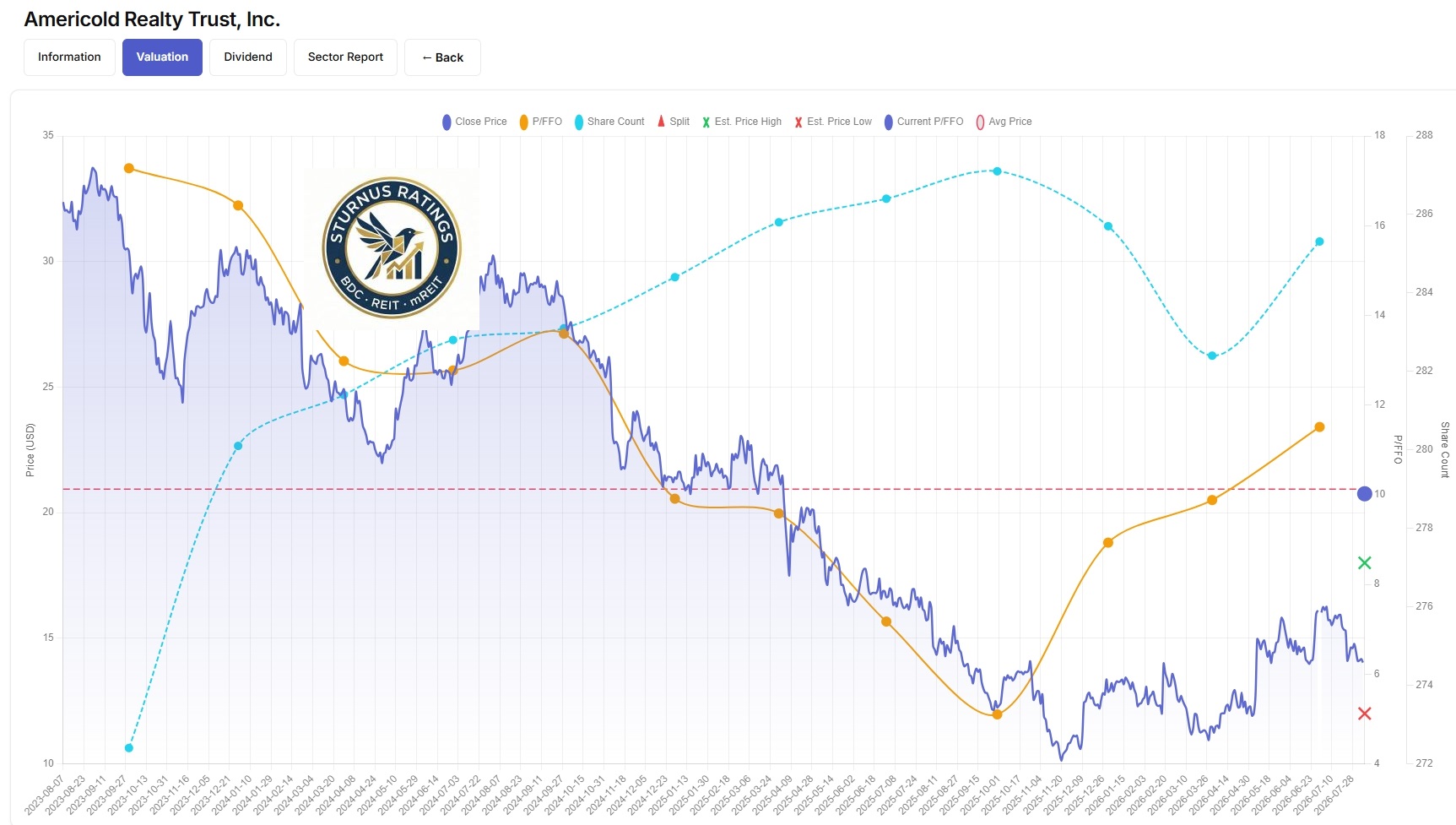
Based on updated 2026 guidance, Americold currently trades around: 15–16× forward AFFO. This valuation remains below most traditional industrial REITs.
Historical Valuation
Historically, Americold has traded between:
- 18×–22× AFFO during favorable industrial REIT environments,
- below 15× during periods of operational weakness.
Current valuation therefore remains below long-term historical averages.
Net Asset Value (NAV)
Cold-storage facilities command premium replacement costs because of:
- specialized refrigeration systems,
- significant energy infrastructure,
- limited development pipeline,
- technical operating requirements.
Private-market values remain relatively resilient despite higher capitalization rates. Current public valuation appears modestly below estimated NAV.
Balance Sheet, Leverage, and Debt Profile
Americold maintains an investment-grade balance sheet.
Strengths include:
- diversified debt maturities,
- substantial liquidity,
- predominantly fixed-rate financing,
- access to unsecured debt markets.
Areas requiring monitoring:
- leverage remains somewhat above leading industrial REIT peers,
- continued development spending limits rapid deleveraging.
Nevertheless, current debt metrics remain manageable.
Interest Rate and Macroeconomic Impact
Americold is moderately sensitive to interest rates.
Higher rates affect:
- development economics,
- acquisition activity,
- refinancing costs,
- valuation multiples.
However, food demand is considerably less cyclical than broader industrial demand, providing an important defensive characteristic.
Lower Federal Reserve policy rates over the next 12–18 months would likely:
- reduce financing costs,
- improve development returns,
- support valuation multiple expansion.
Overall Valuation
Current valuation appears: Modestly undervalued. The shares continue trading below historical valuation despite improving fundamentals and stable long-term demand drivers.
Conclusion
Key Strengths
- Leading global cold-storage platform.
- Defensive food logistics exposure.
- Improving warehouse utilization.
- Strong customer diversification.
- Stable recurring cash flows.
- Conservative dividend payout ratio.
- Investment-grade balance sheet.
- Long-term structural demand from frozen food and pharmaceutical logistics.
Key Risks
- Higher leverage than premier industrial REITs.
- Capital-intensive business model.
- Energy cost inflation.
- Slower AFFO growth than logistics REIT peers.
- Execution risk on automation and development projects.
Near-Term Outlook
Management expects continued operational improvement through the remainder of 2026 as customer inventories normalize, warehouse utilization improves, and productivity initiatives gain traction. Same-store NOI and AFFO growth should remain positive, although the pace is likely to be moderate rather than rapid.
Long-Term Outlook
Americold Realty Trust is uniquely positioned within the industrial REIT sector due to its leadership in temperature-controlled logistics. Long-term demand drivers—including population growth, rising frozen food consumption, pharmaceutical cold-chain requirements, and increasing outsourcing of food logistics—should support steady cash flow growth. Continued investment in automation and operational efficiency also offers opportunities for margin expansion over time.
Investment Thesis
Americold Realty Trust is a specialized industrial REIT with a defensible niche that is difficult to replicate due to the high cost and complexity of developing temperature-controlled warehouses. While earnings growth has lagged traditional industrial REITs in recent years, Q2 2026 results suggest that the business has moved beyond the post-pandemic inventory correction and is returning to a more sustainable growth trajectory.
At approximately 15–16× forward AFFO, the shares trade below both their historical valuation and many industrial REIT peers. Although leverage and capital intensity warrant a modest valuation discount, the improving operating outlook, solid dividend coverage, and favorable long-term industry fundamentals support an attractive risk/reward profile.
Comments (0)
Log in to leave a comment.
No comments yet. Be the first to comment!