Price
At roughly $2.30, PSEC is now trading at: P/NAV = $2.30 / $5.71 = 0.403x
So the discount to reported NAV is approximately: 59.7%
This is slightly less extreme than the ~63% discount I calculated using the previous $6.05 NAV, but it remains extraordinarily large.
For comparison, recent sector data show approximately:
- Ares Capital Corporation: ~1.0x NAV
- Blackstone Secured Lending Fund: ~0.93x
- Golub Capital BDC, Inc.: ~0.92x
- FS KKR Capital Corp.: ~0.65x
PSEC at ~0.40x is therefore at the extreme low end of the BDC valuation spectrum. That is much more important than whether PSEC is "cheap" in a conventional P/NAV sense.
NAV: this is still the biggest problem
The latest numbers make the deterioration painfully clear:
June 2024: $8.74
June 2025: $6.56
March 2026: $6.05
June 2026: $5.71
So over two years: NAV/share has fallen 34.7%. That is the single biggest reason I would not value PSEC at the same multiple as ARCC, BXSL or GBDC. And Q4 was not a stabilization quarter.
NAV/share fell: $6.05 → $5.71 = -$0.34 / -5.6%
The quarterly loss was driven primarily by $83.8M of realized and unrealized investment losses. Prospect reported:
- realized losses: $1.4M
- unrealized losses: $82.4M
- total investment losses: $83.8M
while NII was $77.7M. That is not something I would dismiss.
But there is a very important positive development
The portfolio is clearly being repositioned.
Management has now:
- increased first-lien exposure to 72.5% of cost;
- reduced second-lien exposure to 11.9%;
- completely exited subordinated structured notes/CLO equity;
- reduced lower-yielding real-estate exposure;
- continued selling selected equity-linked investments;
- increased middle-market lending to 85% of investments at cost.
This is precisely the direction I wanted to see. The company says the first-lien mix has increased 840 bps since June 2024, while second-lien exposure has declined 454 bps, and subordinated structured notes have effectively been eliminated. That makes PSEC's portfolio considerably more straightforward than it was several years ago. This is important. The question is whether management can execute it before further NAV destruction overwhelms the benefit.
Credit quality is surprisingly good
This is probably the biggest discrepancy between the stock price and the fundamentals. Non-accruals are only: 0.7% of total assets at fair value. That is unchanged sequentially. And PSEC's own historical middle-market lending statistics show a 0.2% annualized realized loss rate since inception, versus a 1.0% reference loss rate in the KBRA/PitchBook framework cited by management. I would nevertheless treat the 0.2% figure cautiously because it is management's specific methodology and covers realized historical investments rather than the current portfolio. Still, the data do not indicate a portfolio currently experiencing widespread credit deterioration. That's important.
Therefore I would separate two problems: Credit quality: reasonably good. NAV performance: poor. Those are not the same thing. PSEC's NAV losses are not currently being caused by a wave of non-accrual loans.
The $83.8M Q4 unrealized loss deserves more investigation
This is where tomorrow's conference call becomes extremely important. The company had: $82.4M of net unrealized losses but non-accruals remained only 0.7%. That suggests that a significant portion of the mark-downs came from valuation changes in investments that are still performing, rather than simply from loans going on non-accrual. That can actually be good news. If the marks are driven by temporarily wider credit spreads or lower valuation multiples, some of the NAV loss could eventually reverse. But if the marks reflect permanent deterioration in portfolio-company EBITDA, leverage or enterprise values, then the $5.71 NAV may still be too high. This is therefore the question I would ask management tomorrow: "How much of the $82.4M Q4 unrealized loss was attributable to changes in market multiples/credit spreads, and how much reflected fundamental deterioration in individual portfolio companies?"That answer could materially change my valuation.
NII is actually better than I expected
Q4 NII: $0.15/share versus $0.16/share Q3 and $0.17/share Q4 FY2025. So NII has declined, but it has not collapsed.
That is encouraging considering that:
- the portfolio has been shrinking;
- PSEC has sold lower-yielding assets;
- short-term rates have moved lower;
- and the company has been restructuring the portfolio.
The most important number for me is not the absolute decline from $0.17 to $0.15. It is this NII remained approximately $0.15 despite substantial portfolio repositioning. That suggests the new portfolio may have higher-quality earnings characteristics, even if total earnings are lower.
Dividend coverage is now substantially better
The new common dividend is: $0.035/month or $0.105/quarter Q4 NII/share $0.15. Therefore: Dividend coverage = 143%. And the annualized dividend is: $0.42/share. At $2.30 forward yield ≈ 18.3%. That is an exceptionally high yield. More importantly: $0.15 NII vs. $0.105 dividend gives PSEC a reasonable cushion. This is considerably healthier than the previous $0.135 quarterly distribution. The dividend cut was painful, but it appears to have worked.
The dividend is now much safer than the stock price suggests
I would upgrade my dividend assessment from the previous analysis. My current assessment: Dividend safety: 7/10
Not 9/10, because:
- NII is declining;
- NAV is still falling;
- interest rates may continue to pressure floating-rate income;
- the portfolio is shrinking;
- and management has already demonstrated willingness to cut the dividend.
But the current $0.035/month dividend is well supported by Q4 NII.
And the company has now declared:
- September: $0.035
- October: $0.035
which confirms management currently intends to maintain the reduced rate.
There is another interesting positive: Valley Electric
The Valley Electric transaction is quite significant. PSEC expects approximately: $281M net proceeds and reports 20.5% realized gross IRR 4.8x MOIC over the life of the investment. The proceeds were received July 1 and were used to reduce revolver borrowings. Management estimates that the $562.3M revolver balance at June 30 would have been approximately: $322.7M pro forma after applying the Valley Electric proceeds. That's important because June 30 leverage: 28.6% net debt/assets did not yet reflect that deleveraging. So the post-July balance sheet is actually stronger than the reported June 30 balance sheet. This is a meaningful positive.
Liquidity is strong
At June 30: Cash + undrawn revolver = $1.603B and Unencumbered assets = $4.243B or 65.8% of total assets. The weighted-average unsecured debt financing cost was only: 4.78% and maturities are laddered through 2030, with $614.9M of program notes extending as far as 2052. This is not a balance sheet under stress. That is another reason the ~0.40x NAV valuation looks so extreme.
The biggest concern I now have: share count
This deserves more attention than it received in my previous analysis. Common shares outstanding increased from: 455.9M at June 2025 to 512.7M at June 2026. That's an increase of roughly: 12.5%
Meanwhile common NAV went: $2.989B → $2.929B. So despite issuing substantially more common shares, aggregate common NAV actually declined. That is not good for existing shareholders.
And because PSEC's stock trades at a huge discount to NAV, issuing shares is particularly problematic. The DRIP is especially interesting. Prospect's DRIP issues shares at 95% of market price, meaning shareholders participating through the company's DTC DRIP receive a 5% discount. For a stock trading at $2.30, that's approximately: $2.185/share against $5.71 NAV/share. From an existing shareholder's perspective, issuing shares around $2.19 when NAV is $5.71 is highly dilutive to NAV/share unless the transaction is offset by corresponding earnings or other structural benefits.
This is one of the reasons I would not expect PSEC to rapidly converge toward NAV.
Management's 26.7% ownership is interesting — but not sufficient
Management and employees reportedly own: 26.7% of common shares worth approximately $0.8B at NAV. That is a substantial alignment with shareholders. But I would not automatically interpret this as proof that management is shareholder-friendly. The relevant question is: Has management generated attractive per-share returns on that capital? The answer over the last two years is clearly no.
NAV/share has fallen 34.7% since June 2024. So management ownership is a positive alignment factor, but performance still has to be demonstrated.
Updated valuation scenarios
This is where the new $5.71 NAV changes my numbers. At approximately $2.30, the market is effectively assigning: ~0.40x NAV. I think 0.40x is too low if NAV has finally stabilized. But I would not assign PSEC a 0.70–0.80x multiple yet. My reasonable normalized range is: 0.50–0.60x NAV which translates to $2.86–$3.43. That's a potential capital appreciation of approximately: +24% to +49% plus an ~18% dividend yield. That is an unusually attractive potential total-return setup.
But there is a catch
Suppose NAV falls another 10%: $5.71 → $5.14 At 0.40x $2.06. So the downside from today's $2.30 is only about 10%. This is precisely why PSEC has become interesting. The market is already pricing in a lot of bad news. The asymmetry is improving.
My revised scenario analysis: Bear case
NAV falls to ~$5.10–5.30 and P/NAV remains 0.35–0.40x → $1.80–2.10
Base case
NAV stabilizes around $5.50–5.80 and multiple expands to 0.50–0.55x → $2.75–3.20
Bull case
NAV stabilizes/rebounds toward $5.80–6.00 and P/NAV reaches 0.60x → $3.50–3.60
The bull case does not require PSEC to become a premium BDC.
My biggest change from the previous analysis
Now we have Q4. And after seeing it, my conclusion is: I would be more willing to own PSEC at ~$2.30 than I was before the report. But not because Q4 was excellent. It wasn't. The Q4 NAV decline of 5.6% is disappointing.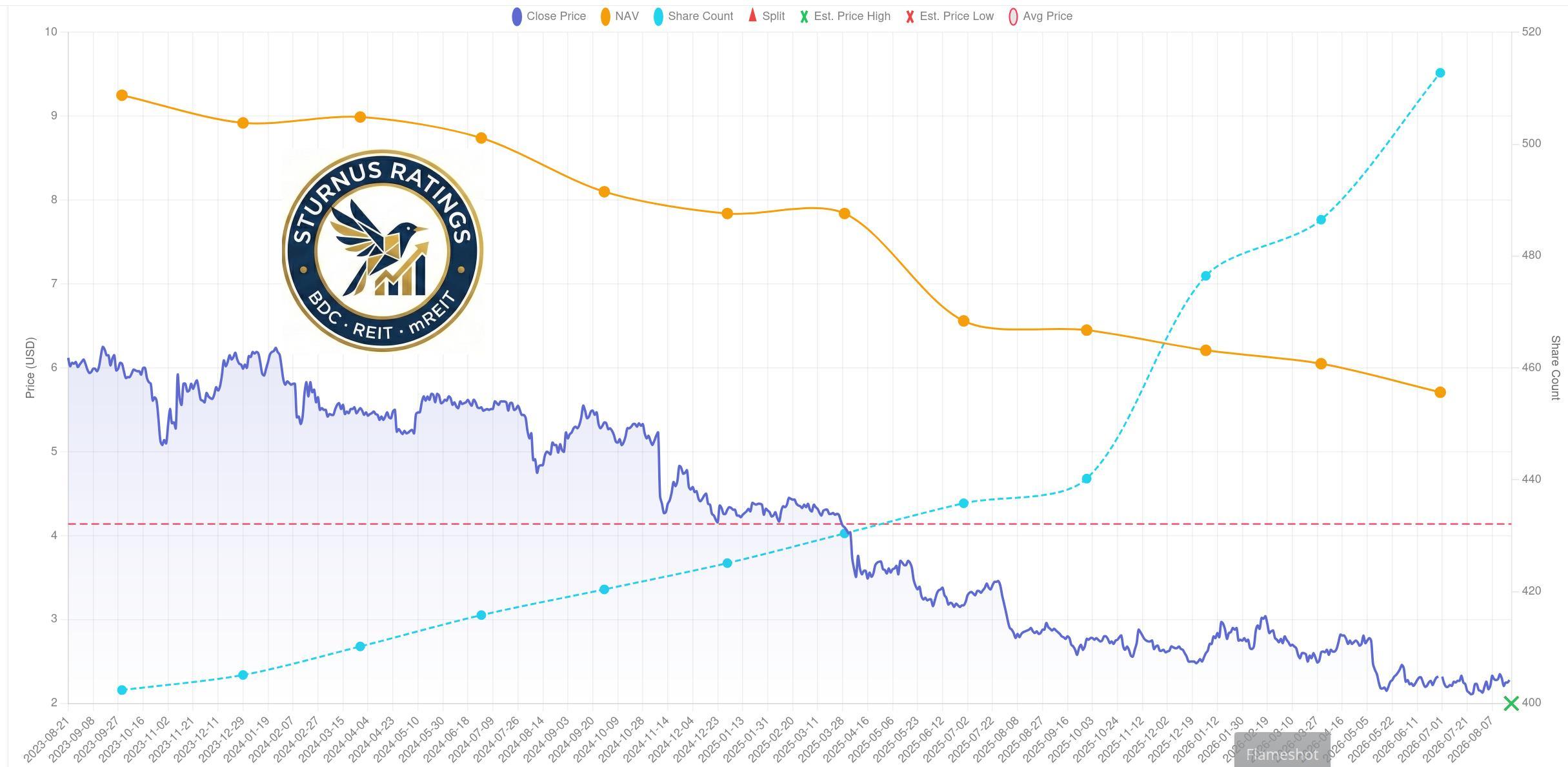
I would buy it because:
- P/NAV is only ~0.40x.
- NII remains ~$0.15/share.
- Dividend coverage is ~143%.
- Non-accruals are only 0.7%.
- First-lien exposure is rising.
- CLO/subordinated structured notes are gone.
- Valley Electric provides ~$281M of cash proceeds.
- Post-sale leverage should be lower than the reported 28.6%.
- Liquidity remains substantial.
- The market already prices PSEC as if its NAV is deeply impaired.
The critical negative remains:
NAV/share fell from $6.56 to $5.71 in only one year. Until that stops, I cannot call PSEC a high-quality BDC.
Current rating
PSEC at ~$2.30: SPECULATIVE BUY
I would now consider $2.20–$2.35 an attractive entry zone for a high-risk/high-income position, provided the position size reflects the NAV risk. I would not make PSEC a core BDC holding comparable to ARCC, BXSL or MAIN. But at roughly 40% of reported NAV, I think the market is now demanding an unusually large margin of safety.
Comments (0)
Log in to leave a comment.
No comments yet. Be the first to comment!