Public Storage is the largest U.S. self-storage REIT and one of the most important publicly traded real estate companies in the sector. The business has several structural advantages: a highly fragmented underlying industry, relatively low property-level capital requirements, short lease durations that allow rents to reset quickly, and a geographically diversified portfolio.
However, the current investment case is complicated by two opposing forces:
- the completed National Storage Affiliates Trust acquisition materially expands Public Storage's scale and long-term growth platform;
- but same-store self-storage fundamentals remain relatively soft, with Q2 2026 same-store revenue declining 0.6% year over year.
My overall conclusion is that Public Storage remains an exceptionally high-quality REIT, but at approximately $330 per share, the valuation already reflects a substantial portion of that quality and the strategic benefits of the NSA transaction.
Price
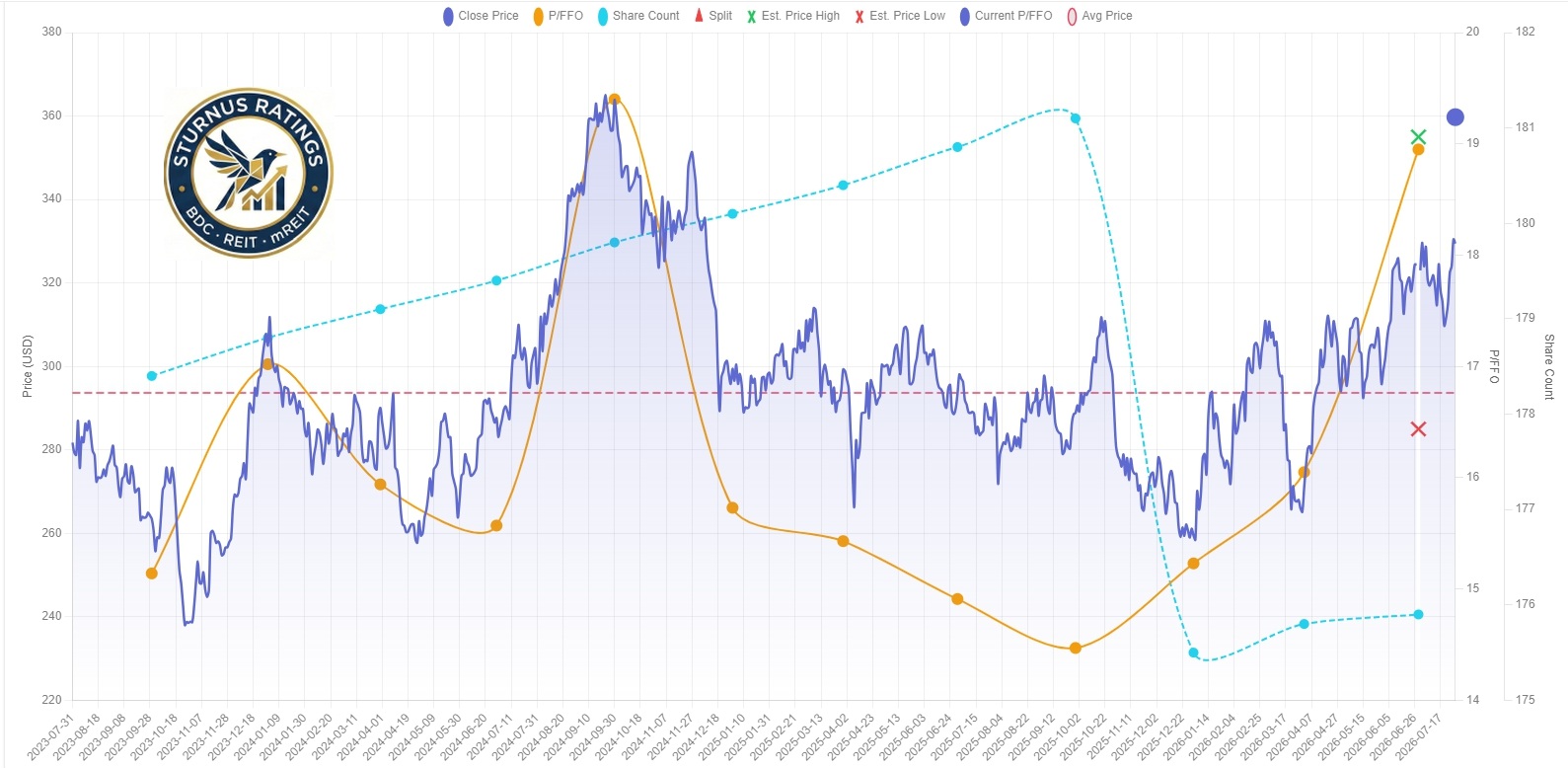
Public Storage's shares closed at approximately $329.58 on July 29, 2026, according to market data reported after the Q2 earnings release. The stock was up approximately 9.3% over the previous three months and 14.2% over the previous 12 months. The July 28 closing price was approximately $330.47, compared with a 52-week range of approximately $292.19–$335.05. This means the stock is trading very close to its 52-week high. That is important from a risk/reward perspective.
Public Storage is not being priced as a distressed REIT or even as a temporarily unpopular REIT. The market is already assigning significant value to:
- the quality of its balance sheet;
- its scale;
- the National Storage Affiliates Trust transaction;
- its long-term dividend record;
- and the possibility of a future recovery in self-storage fundamentals.
The stock's recent performance has therefore been stronger than the underlying same-store operating numbers might initially suggest.
Q2 2026 results
The Q2 results were mixed.
Public Storage reported:
- Q2 net income per share: $2.55, up 44.9% year over year;
- Core FFO per share: $4.17, compared with $4.28 in Q2 2025;
- same-store revenue: down 0.6% year over year;
- and the company raised its full-year 2026 Core FFO guidance.
The decline in Core FFO per share is worth noting. The headline 44.9% increase in GAAP net income is not representative of the underlying recurring economics of the business. For a REIT, Core FFO and same-store NOI are much more important. The most encouraging aspect of the report is therefore not the GAAP earnings increase. Public Storage raised its 2026 Core FFO guidance to approximately $16.75–$17.05 per share, compared with the previous $16.35–$17.00 range. The new midpoint is approximately $16.90 per share.
At approximately $329.58, this implies a forward Core FFO multiple of roughly: $329.58 ÷ $16.90 = 19.5x
That is a premium valuation. The market is therefore assuming that Public Storage deserves a significant quality premium and that the NSA transaction will ultimately create meaningful long-term value.
Key catalysts affecting the share price
1. Integration of National Storage Affiliates Trust
The most important company-specific catalyst is now the integration of National Storage Affiliates Trust. The transaction has transformed Public Storage into an even larger self-storage platform, taking the company beyond 4,500 locations across the United States. The strategic rationale is compelling.
Greater scale should provide:
- purchasing efficiencies;
- technology efficiencies;
- greater operating leverage;
- broader geographic diversification;
- stronger brand recognition;
- and greater access to data and customer acquisition capabilities.
However, the transaction also increases execution risk. Investors need to see that the acquired portfolio can generate attractive returns without sacrificing balance-sheet quality or per-share FFO growth. The key question is not whether Public Storage is larger. It is whether the acquisition is accretive to long-term intrinsic value per share. So far, the increased 2026 guidance is encouraging.
2. Same-store revenue stabilization
This is the most important operating catalyst. Q2 same-store revenue declined approximately 0.6% year over year. That is not a crisis, but it indicates that the self-storage operating environment remains soft.
Self-storage demand is influenced by:
- household formation;
- home sales;
- moving activity;
- employment;
- small-business formation;
- and consumer confidence.
The sector benefited enormously during the pandemic as people moved, renovated homes, and changed living arrangements. The subsequent normalization has created a more difficult environment.
The next major catalyst would therefore be a return to positive same-store revenue growth. A progression such as: negative revenue growth → flat revenue → 2–3% growth could materially improve investor sentiment.
3. Acquisition synergies
The NSA transaction could become a significant source of long-term value. Public Storage already has one of the industry's largest platforms.
Adding thousands of properties should provide opportunities to:
- optimize rents;
- improve occupancy;
- reduce operating costs;
- dispose of lower-quality assets;
- and redeploy capital into higher-return markets.
If management can generate meaningful synergies, the transaction could support AFFO growth beyond what the underlying same-store portfolio alone could achieve. The risk is that the market has already priced in much of the expected benefit.
4. Interest rates
Public Storage is highly sensitive to long-term interest rates.
The company's business model is attractive in a low-rate environment because:
- the dividend becomes more competitive with bonds;
- acquisition financing becomes cheaper;
- property capitalization rates can decline;
- and REIT valuation multiples can expand.
Conversely, higher Treasury yields create pressure on valuation. At roughly 19.5x forward Core FFO, Public Storage is particularly sensitive to multiple compression. A 1–2 turn reduction in the FFO multiple could offset several years of FFO growth. Therefore, the direction of long-term interest rates is likely to remain one of the largest external drivers of PSA's share price.
Technical and fundamental sentiment
The technical picture is strong. The shares are close to their 52-week high and have generated positive returns over both the three- and twelve-month periods. Fundamentally, however, the picture is more nuanced.
The market is rewarding:
- the NSA acquisition;
- the company's scale;
- the strong balance sheet;
- and expectations of future operating improvement.
At the same time:
- same-store revenue remains negative;
- Core FFO per share declined year over year in Q2;
- and the valuation is already high.
My interpretation is that market sentiment is bullish on the long-term story but increasingly dependent on successful execution. At $330+, investors have less tolerance for disappointing integration results or prolonged same-store weakness.
Dividend
Public Storage is a highly attractive dividend REIT, although its yield is relatively modest compared with higher-yielding REITs.
The company declared a regular quarterly common dividend of $3.00 per share for Q2 2026. That implies an annualized dividend of: $12.00 per share
At a share price of approximately $329.58, the forward dividend yield is approximately: $12.00 ÷ $329.58 = 3.64%
This is a respectable yield, but the real attraction is not the starting yield alone.
The appeal is the combination of:
- dividend safety;
- long-term dividend growth potential;
- high-quality real estate;
- and substantial retained cash flow.
Dividend history and growth trends
Public Storage has a long history of returning capital to shareholders. The company declared its 130th consecutive quarterly common dividend in 2026, demonstrating the consistency of its shareholder distribution policy. The current $3.00 quarterly dividend has remained unchanged through the first half of 2026. This is important because the current self-storage environment is not particularly strong.
Management is therefore prioritizing:
- dividend sustainability;
- balance-sheet flexibility;
- and integration of the NSA transaction
rather than aggressively increasing the payout. I view this as prudent.
The most attractive dividend-growth scenario would be one in which:
- same-store revenue returns to positive growth;
- NSA synergies are realized;
- Core FFO per share accelerates;
- and management can resume meaningful dividend growth.
AFFO payout ratio and dividend coverage
Using the new 2026 Core FFO guidance midpoint of approximately $16.90 per share and an annual dividend of $12.00, the implied Core FFO payout ratio is: $12.00 ÷ $16.90 = approximately 71%
This is a healthy payout ratio for a mature REIT.
It leaves approximately 29% of recurring FFO available for:
- capital expenditures;
- debt repayment;
- acquisitions;
- and retained cash flow.
The actual AFFO payout ratio will be somewhat different because AFFO adjusts FFO for recurring capital expenditures and other items. The Q2 results do not suggest any immediate threat to dividend sustainability.
Dividend safety
Dividend safety: VERY HIGH
I consider Public Storage's dividend highly sustainable.
The principal reasons are:
- high-quality real estate;
- recurring rental income;
- low tenant concentration at the individual customer level;
- strong balance sheet;
- substantial scale;
- and a payout ratio around 70% of Core FFO.
Self-storage has another important advantage. Unlike office or specialized healthcare real estate, the landlord is generally not dependent on a small number of large tenants. Public Storage has millions of individual customers. If one customer leaves, the financial impact is negligible. This creates a highly diversified revenue stream. The main risk is therefore not tenant default. It is occupancy and rental-rate pressure across the entire portfolio.
Potential risks to future dividend payments
The probability of a dividend cut appears low.
The main risks would be:
1. Prolonged self-storage weakness
If same-store NOI declined for multiple years, FFO growth could stagnate.
2. NSA integration problems
If the acquisition fails to generate expected synergies, retained cash flow could be lower than anticipated.
3. Excessive leverage
A major acquisition can increase financial risk if funded too aggressively with debt.
4. Higher interest rates
Refinancing costs could increase and valuation multiples could compress.
5. Weak housing activity
Lower home sales and lower household mobility can reduce self-storage demand. Overall, I see the dividend as very safe, with dividend growth being the primary variable rather than dividend survival.
Valuation
Price-to-FFO and Price-to-AFFO
At approximately $329.58, Public Storage trades at roughly 19.5x forward Core FFO, using the midpoint of the updated 2026 guidance.
That is a premium valuation.
The premium is justified by:
- the company's scale;
- portfolio diversification;
- balance-sheet strength;
- high dividend safety;
- and the relatively attractive economics of self-storage real estate.
However, the valuation is not cheap.
At nearly 20x forward Core FFO, the market is effectively assuming that:
- same-store growth eventually improves;
- the NSA transaction is successfully integrated;
- the company maintains its financial discipline;
- and long-term FFO growth resumes.
If those assumptions are correct, the valuation is defensible. If same-store growth remains weak for several years, the multiple could compress.
My valuation view
19.5x forward Core FFO is reasonable for a premium self-storage REIT, but it does not provide a large margin of safety.
I would classify the stock as: Fairly valued to moderately overvalued. The business itself is excellent. The stock price is simply less compelling.
Historical valuation range
Public Storage has historically commanded a premium valuation because of its:
- scale;
- brand;
- operating platform;
- strong balance sheet;
- and real estate quality.
The valuation has nevertheless fluctuated significantly with interest rates. When Treasury yields rise, investors tend to demand a higher dividend yield from REITs. This causes valuation multiples to contract. When rates decline, the opposite can occur. At current prices, the stock appears to be pricing in a relatively favorable long-term interest-rate environment.
Therefore, I would be hesitant to buy aggressively at $330 unless I had a strong conviction that:
- rates will decline;
- same-store revenue growth will accelerate;
- or the NSA transaction will produce substantial incremental value.
NAV considerations
NAV is particularly relevant for Public Storage because self-storage properties have relatively transparent market values.
The assets are:
- relatively small;
- geographically diversified;
- operationally simple;
- and generally easier to value than specialized properties.
However, cap rates remain highly sensitive to interest rates. If cap rates rise by 50–100 basis points, estimated NAV can decline even if the physical properties remain fully occupied. Public Storage's scale also creates an interesting dynamic.
The company can potentially create value by:
- buying smaller portfolios;
- improving operations;
- consolidating management;
- and selling non-core properties.
Therefore, I believe PSA's economic NAV should be considered alongside its platform value. The market is not simply valuing the buildings. It is valuing the entire operating system surrounding those buildings. The NSA acquisition significantly increases that platform value.
Balance sheet quality, leverage and debt profile
The balance sheet is one of Public Storage's greatest strengths.
The company has historically maintained:
- investment-grade credit ratings;
- substantial liquidity;
- diversified sources of capital;
- and relatively conservative leverage.
The major issue following the NSA acquisition is whether Public Storage can maintain this conservative profile while integrating such a large transaction. This is the key balance-sheet question for 2026–2027.
I would be comfortable with modestly higher leverage if:
- the acquisition generates strong FFO growth;
- integration proceeds smoothly;
- and the company retains its investment-grade credit profile.
I would become more cautious if leverage rose substantially while same-store fundamentals remained weak. That is the scenario the market is currently hoping to see.
Impact of interest rates and macroeconomic conditions
Public Storage has a relatively defensive operating model, but its valuation remains highly interest-rate sensitive.
Higher interest rates
Negative for:
- valuation multiples;
- refinancing costs;
- acquisition financing;
- and NAV.
Lower interest rates
Positive for:
- valuation multiples;
- dividend attractiveness;
- acquisition economics;
- property values;
- and external growth.
Housing market
The housing market is particularly important.
Self-storage demand is often associated with:
- home purchases;
- relocations;
- downsizing;
- divorce;
- college attendance;
- and household formation.
A weak housing transaction market can therefore reduce demand. However, self-storage also benefits from life events that occur in all economic environments. This creates a relatively resilient demand profile. The most important long-term fundamental factor is therefore household formation and population growth, while the most important short-term factor is supply and rental-rate competition.
Valuation assessment
At approximately $330 per share, I consider Public Storage: FAIRLY VALUED TO MODERATELY OVERVALUED
My approximate valuation zones would be:
- Below $290: Strong Buy
- $290–310: Attractive
- $310–330: Fair value
- Above $330: Expensive unless FFO growth accelerates
These are not precise price targets. They represent the valuation range where I believe the expected long-term return adequately compensates for business and interest-rate risk. At $330, the 3.6% dividend yield is attractive from a safety perspective but not sufficiently high, in my view, to compensate for the possibility of multiple compression. The stock would become significantly more attractive if it fell toward $290–300 without a corresponding deterioration in the underlying business.
Conclusion
Key strengths
Public Storage is an exceptionally high-quality REIT.
Its key advantages include:
- dominant scale;
- massive geographic diversification;
- millions of individual customers;
- low tenant concentration;
- relatively low recurring capital expenditure requirements;
- strong brand;
- high-quality balance sheet;
- long dividend history;
- and significant operating leverage.
The completion of the National Storage Affiliates Trust acquisition adds another potentially important growth engine.
The strategic opportunity is substantial.
Public Storage now has an even larger platform from which to:
- optimize operations;
- improve occupancy;
- increase rents;
- reduce costs;
- and allocate capital more efficiently.
Key risks
The main risks are:
- weak same-store revenue growth;
- a prolonged self-storage supply cycle;
- higher interest rates;
- integration risk from NSA;
- and valuation compression.
The most important point is that Public Storage's principal risk today is not its balance sheet or dividend. It is the possibility that investors have already priced in too much future improvement. At nearly 20x forward Core FFO, the market expects the business to eventually return to stronger growth. If that happens, the stock can justify its valuation. If not, returns could be mediocre even if the business remains fundamentally healthy.
Near-term outlook
The near-term outlook is neutral to moderately positive. The Q2 results show that same-store fundamentals remain soft, but the company has increased its 2026 Core FFO guidance to approximately $16.75–$17.05 per share. The key issue now is the NSA integration.
I would closely monitor:
- same-store revenue;
- same-store NOI;
- occupancy;
- move-in and move-out trends;
- street-rate growth;
- realized rent growth;
- NSA integration synergies;
- leverage;
- acquisition and disposition activity;
- and 2027 Core FFO guidance.
The July 30 earnings call should be particularly valuable because management can provide more context on how the enlarged portfolio is performing and how quickly synergies can be realized.
Long-term outlook
My long-term outlook is bullish.
Self-storage remains an attractive real estate sector because:
- lease terms are short;
- rents can be repriced relatively quickly;
- capital expenditure requirements are comparatively modest;
- customer concentration is extremely low;
- and demand is supported by numerous life events.
Public Storage adds the advantages of:
- enormous scale;
- strong brand recognition;
- extensive operating data;
- and access to low-cost capital.
The NSA acquisition could strengthen these competitive advantages further. The biggest opportunity is that Public Storage can use its scale to generate operating efficiencies and external growth that smaller competitors cannot match.
Investment thesis
My overall rating: HOLD / ACCUMULATE ON PULLBACK
Public Storage is a great company at a price that is currently close to fair value, but not an obvious bargain.
At approximately $330:
- forward Core FFO multiple: ~19.5x
- annualized dividend: $12.00
- forward dividend yield: ~3.6%
- Core FFO payout ratio: ~71%
- 2026 guidance: $16.75–$17.05 Core FFO/share
The dividend is extremely safe, the balance sheet is strong, and the long-term business model is attractive. The NSA transaction provides an additional potential growth catalyst. However, the shares have already recovered strongly and are close to their 52-week high, while same-store revenue remains slightly negative. Preferred entry point would be below $300, with the $290–300 range offering a substantially better risk/reward profile. At that level, the forward Core FFO multiple would fall toward approximately 17–18x, while the dividend yield would rise toward approximately 4%.
Public Storage remains one of the highest-quality REIT businesses available to long-term investors. The dividend is very safe, the balance sheet is a major strength, and the NSA acquisition could materially improve long-term growth. But at around $330, I believe the market is already giving the company considerable credit for future synergies and a recovery in self-storage fundamentals. I would therefore hold existing shares and accumulate selectively on weakness rather than chase the stock at current levels. The most attractive setup would be a market-driven pullback toward $290–300 while same-store fundamentals remain intact. That would allow investors to own the same high-quality business at a valuation that provides a considerably larger margin of safety.
Judgment: High-quality business — very safe dividend — excellent long-term assets — but current valuation leaves only a moderate margin of safety.
Comments (0)
Log in to leave a comment.
No comments yet. Be the first to comment!