Ventas, Inc. is currently undergoing a significant transformation. Historically known primarily as a diversified healthcare REIT, the company has increasingly shifted its portfolio toward senior housing operating properties (SHOP), where it participates directly in the operating economics of senior living communities rather than simply collecting contractual rent.
That strategy is now producing very strong operating growth. The central investment question is whether Ventas can convert the current senior housing recovery and demographic tailwind into sustained per-share AFFO growth without taking excessive balance-sheet or dilution risk. My conclusion is cautiously bullish on the business, but much more selective on the share price after a very strong 2026 rally.
Price
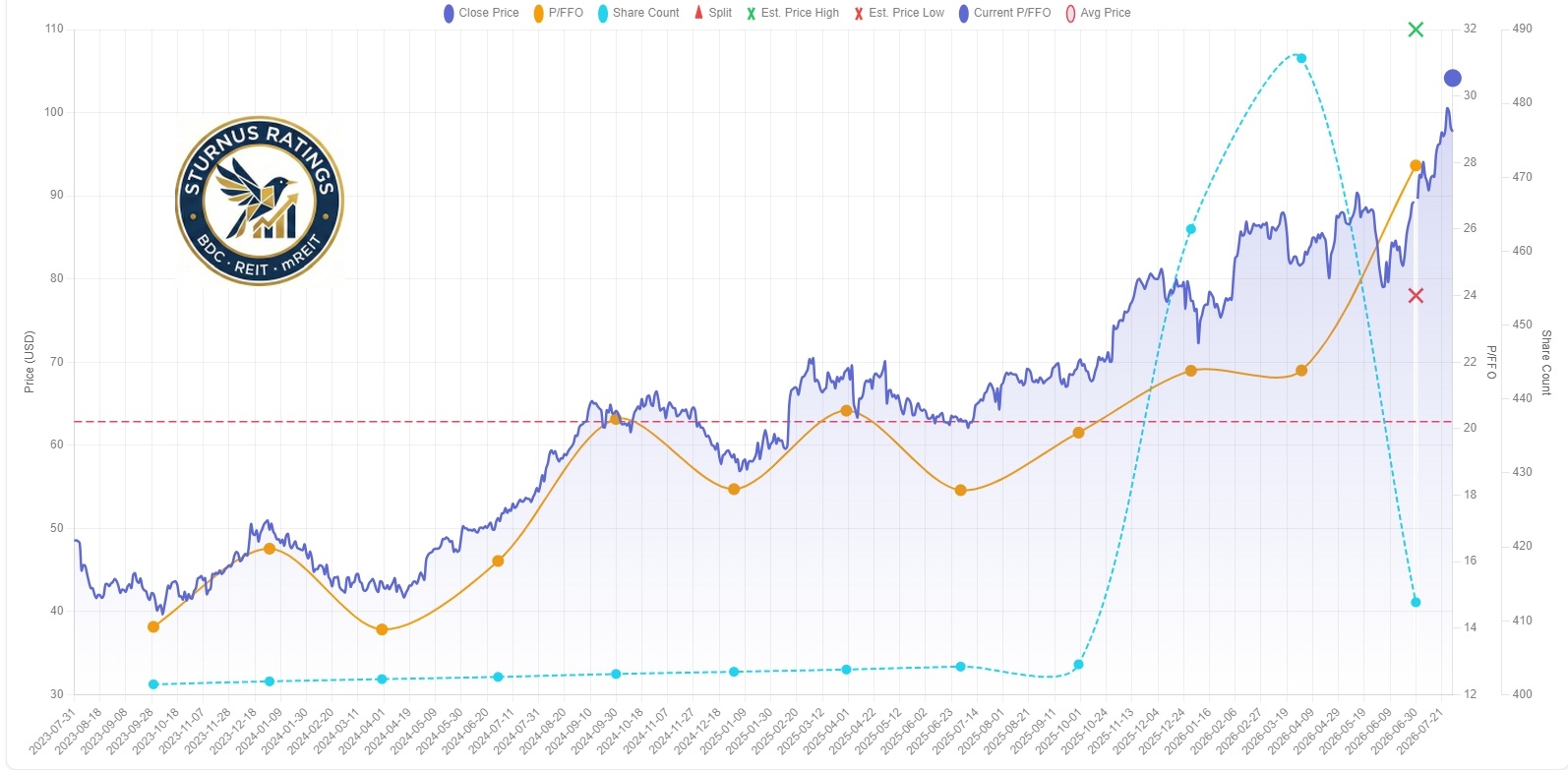
Ventas, Inc. has been one of the strongest-performing healthcare REITs in 2026. The shares reached a record high of approximately $100.98 in late July 2026. Market data showed the stock up approximately 29.5% year to date and 53.6% over the prior 12 months as of July 27. That performance is fundamentally justified to a significant extent. The company's operating results have improved materially, particularly in the Senior Housing Operating Portfolio (SHOP). However, the stock's appreciation has also changed the risk/reward equation. At around $100 per share, investors are no longer buying a turnaround at a depressed valuation.
They are buying a REIT whose market valuation already reflects considerable confidence in:
- senior housing demand;
- occupancy growth;
- pricing power;
- acquisitions;
- and continued SHOP NOI expansion.
That makes the upcoming earnings trajectory increasingly important.
The transformation of Ventas, Inc.
Ventas' portfolio is now increasingly centered on three major businesses:
- Senior Housing Operating Portfolio (SHOP)
- Outpatient Medical and Research (OM&R)
- Triple-Net Leased (NNN) properties
At year-end 2025, SHOP generated approximately 49.4% of total portfolio NOI, while OM&R contributed 24.7% and NNN 24.6%. The 2025 portfolio included 752 SHOP properties, 409 OM&R properties and 213 NNN properties. This composition matters enormously.
SHOP has higher operating risk than traditional triple-net healthcare real estate because Ventas participates directly in:
- labor costs;
- occupancy;
- food costs;
- insurance;
- utilities;
- and other operating expenses.
But it also has significantly greater upside when senior housing fundamentals improve. That is exactly what has been happening.
Recent operating performance
Ventas' 2025 results were very strong. Normalized FFO increased approximately 9% year over year to $3.48 per share, while total company NOI increased 16% and total same-store cash NOI increased 8%. SHOP same-store cash NOI grew more than 15%, with U.S. SHOP growth exceeding 18%. The Q1 2026 results continued that momentum.
Ventas reported:
- SHOP same-store cash NOI growth above 15%;
- same-store cash operating revenue growth of nearly 9%;
- approximately 310 basis points of occupancy growth;
- and 5% RevPOR growth.
The company also closed approximately $1.7 billion of senior housing investments during Q1 2026. These are exceptionally strong numbers for a mature healthcare REIT. The investment thesis has therefore evolved. This is no longer primarily a story about stabilizing a healthcare real estate portfolio.
Key catalysts affecting the share price
1. Senior housing occupancy
This is the most important fundamental catalyst. The senior housing industry suffered from significant occupancy pressure during and after the pandemic. The recovery is now becoming a major earnings driver. Higher occupancy creates substantial operating leverage because much of the cost structure of senior living is relatively fixed.
For example:
More occupied units → higher revenue → relatively modest incremental operating costs → disproportionately higher NOI.
That is why occupancy growth can have a much larger effect on SHOP NOI than simply increasing rents. Ventas' recent performance demonstrates exactly this mechanism. The Q1 2026 data showed approximately 310 basis points of average occupancy growth combined with 5% RevPOR growth. If occupancy continues to rise, Ventas could potentially sustain strong NOI growth even if RevPOR growth moderates.
2. The aging U.S. population
This is the strongest long-term structural catalyst. The number of Americans entering the prime senior housing demographic is increasing. The key issue is that senior housing demand tends to accelerate as the population reaches older age brackets where assisted living and other senior housing services become increasingly relevant. Ventas is therefore positioned to benefit from a demographic trend that could persist for decades. The company itself explicitly frames its strategy around serving a large and growing aging population. This is not merely a cyclical recovery. It is a structural demand tailwind. The important question is whether the supply of new senior housing units grows fast enough to meet demand.
3. Senior housing supply constraints
This may be underappreciated.
New senior housing development has been constrained by:
- high construction costs;
- elevated interest rates;
- financing difficulties;
- labor shortages;
- and limited availability of attractive development capital.
If demand accelerates faster than new supply, existing operators could experience:
- higher occupancy;
- stronger pricing;
- and expanding margins.
This would be particularly beneficial to Ventas because of its large SHOP portfolio. I consider the combination of aging demographics + constrained new supply one of the strongest long-term fundamentals supporting VTR.
4. External growth
Ventas has been highly active in acquiring senior housing properties. The company completed approximately $2.5 billion of senior housing investments during 2025 and another $1.7 billion during Q1 2026. This creates significant growth potential. However, there is an important distinction between: growth in total FFO and growth in FFO per share. Ventas has used equity forward sales to help fund its investment program. During Q1 2026, it settled 10.6 million shares under equity forward agreements for net proceeds of approximately $0.8 billion, while $1.6 billion of unsettled equity forwards remained outstanding at quarter-end. This is a critical issue for shareholders. So far, management's strong NOI growth suggests the strategy is working.
But investors should closely monitor:
- acquisition cap rates;
- stabilized NOI yields;
- financing costs;
- share issuance;
- and normalized FFO per share.
I would consider per-share FFO growth the most important measure of whether the external-growth strategy is genuinely creating shareholder value.
5. Interest rates
Interest rates remain an important valuation catalyst.
Ventas benefits from lower long-term rates because:
- the value of its real estate increases;
- its cost of capital falls;
- acquisition spreads improve;
- and its dividend becomes more attractive.
The company is also a relatively long-duration asset because healthcare properties have long economic lives and significant replacement costs. A decline in Treasury yields could therefore support both: higher NAV and a higher FFO multiple. The opposite is also true. At around $100, the stock is more vulnerable to a valuation correction if long-term interest rates unexpectedly rise.
Technical and fundamental market sentiment
The market sentiment toward Ventas is currently strongly bullish. The stock's recent performance confirms that investors are increasingly recognizing the strength of the senior housing recovery. The shares reached a record high around $100.98 in July, after rising approximately 54% over the previous year. However, there is a potential problem. When a stock rises this quickly, expectations rise with it.
The market will increasingly demand:
- continued double-digit SHOP NOI growth;
- successful acquisitions;
- strong occupancy gains;
- and positive FFO-per-share growth.
If growth merely moderates from exceptional to good, the stock could still experience multiple compression. Therefore, I would describe the current sentiment as: Fundamentally bullish, but increasingly expectation-sensitive.
Dividend
Ventas currently pays a quarterly dividend of approximately $0.52 per share, or approximately $2.08 annually. At a share price near $100, the forward dividend yield is approximately: 2.1% That is a relatively modest yield for a healthcare REIT. However, the dividend should not be evaluated purely on current yield. Ventas has been rebuilding its dividend after the pandemic period and has recently returned to dividend growth. The company has paid dividends for approximately 28 consecutive years, according to recent market data.
Dividend history and growth trends
Ventas' dividend history is complicated by the COVID-19 period and the stress experienced by healthcare and senior housing operators. The company reduced its dividend during the pandemic, reflecting the extreme uncertainty surrounding senior housing occupancy and healthcare real estate. That history means I would not classify Ventas as a traditional "sleep well at night" dividend-growth REIT in the same category as companies with uninterrupted multi-decade dividend growth. However, the current situation is substantially better. The senior housing business is recovering. SHOP NOI is growing strongly. Occupancy is improving. And normalized FFO is increasing. That provides a much stronger foundation for future dividend growth.
AFFO payout ratio and dividend coverage
Using approximately $2.08 in annual dividends and the 2025 normalized FFO of $3.48 per share, the payout ratio based on normalized FFO is approximately: $2.08 ÷ $3.48 = 60%
This is a conservative payout ratio. Even allowing for the difference between FFO and AFFO, the dividend appears to have a substantial coverage cushion. However, investors should recognize that Ventas' rapidly growing SHOP business makes AFFO conversion more complicated than for a pure triple-net REIT.
SHOP requires:
- ongoing maintenance capital;
- operating expenditures;
- and direct management of property-level businesses.
Therefore, I would focus on:
- normalized FFO;
- AFFO;
- recurring capital expenditures;
- and free cash flow after maintenance capex.
The dividend currently appears well covered.
Dividend safety
Dividend safety: HIGH
I believe the current dividend is safe.
The combination of:
- improving senior housing occupancy;
- strong same-store NOI growth;
- a roughly 60% normalized FFO payout ratio;
- investment-grade balance-sheet characteristics;
- and significant liquidity
provides a meaningful margin of safety.
The main risk is not a sudden dividend cut.
It is that management's aggressive investment strategy could increase:
- leverage;
- equity dilution;
- or capital requirements.
Even in that scenario, I would expect management to prioritize dividend sustainability.
My assessment:
Dividend safety: High
Dividend growth potential: Moderate to high
Current income attractiveness: Low to moderate
The current yield is simply not high enough for investors whose primary objective is maximizing immediate income.
Potential risks to future dividend payments
1. Senior housing operating risk
SHOP is more economically sensitive than triple-net real estate.
A decline in occupancy or a significant increase in labor costs could pressure NOI.
2. Operator performance
Ventas' senior housing properties rely on operating partners and management teams.
Weak execution could reduce property-level profitability.
3. Acquisition and equity issuance
If acquisitions are funded through significant equity issuance without sufficient incremental FFO, per-share cash flow could stagnate.
4. Leverage
Rapid external growth could increase financial risk.
5. Healthcare policy
Changes to Medicare, Medicaid or healthcare reimbursement can indirectly affect tenants and operators.
6. Interest rates
Higher rates could increase the cost of capital and reduce valuation. Overall, however, I believe the dividend has a substantial safety margin at current operating levels.
Valuation
Price-to-FFO and Price-to-AFFO
This is where my view becomes more cautious. At approximately $100 per share, Ventas is no longer a cheap healthcare REIT. Using 2025 normalized FFO of $3.48 per share would imply a historical P/FFO multiple of approximately: $100 ÷ $3.48 = 28.7x That number is not necessarily the right forward valuation because 2026 FFO is expected to be significantly higher. This is justified to some extent. Ventas' SHOP segment is growing very rapidly. However, investors must now pay for that growth upfront.
The valuation therefore depends heavily on management's ability to sustain:
- double-digit SHOP NOI growth;
- occupancy gains;
- and accretive acquisitions.
If normalized FFO per share grows rapidly, the current multiple can compress naturally as earnings catch up. If growth slows, the valuation could become vulnerable.
Historical valuation range
Ventas historically traded at lower valuation multiples during periods when:
- senior housing occupancy was weak;
- the pandemic affected operations;
- interest rates were high;
- and investors questioned the sustainability of the business model.
The current valuation reflects a very different environment.
The market now sees:
- improving senior housing fundamentals;
- stronger occupancy;
- better operating margins;
- and long-term demographic demand.
This justifies a valuation premium. But the stock's recent rally has arguably moved the shares from recovery valuation toward growth valuation. That transition is important. The easy part of the investment thesis—buying a high-quality healthcare REIT after a period of severe operational stress—has already passed. The next phase requires execution.
NAV considerations
NAV is particularly relevant for Ventas because the company's assets include:
- senior housing;
- medical office;
- research properties;
- and triple-net healthcare real estate.
The valuation of these assets depends heavily on:
- cap rates;
- property quality;
- location;
- operator quality;
- and lease structure.
The SHOP portfolio deserves special attention.
Its value should be assessed based on both:
- the underlying real estate;
- the earnings power of the operating business.
As senior housing occupancy increases, the value of the properties can rise even without major cap-rate compression because their stabilized NOI increases. That creates a potentially powerful NAV tailwind. The risk is that higher interest rates push cap rates upward at the same time. Therefore, Ventas has two competing forces: Higher NOI → higher NAV versus Higher cap rates → lower NAV. At present, the strong NOI growth appears to be winning.
Balance sheet quality, leverage and debt profile
Ventas has maintained a relatively strong financial position. At year-end 2025, the company reported approximately $5.3 billion of liquidity, while net debt-to-Further Adjusted EBITDA was approximately 5.2x. The company also used equity funding to support senior housing investment activity. The 5.2x leverage level is not exceptionally low, but it is manageable for a large diversified healthcare REIT.
The important point is that management appears to be conscious of balance-sheet constraints. The use of equity forward agreements allows Ventas to fund growth without relying entirely on debt.
However, that creates the previously discussed dilution risk.
I would therefore classify the balance sheet as:
Good, with leverage that warrants monitoring.
The key target should be maintaining:
- investment-grade ratings;
- sufficient liquidity;
- manageable debt maturities;
- and adequate interest coverage.
The company should avoid allowing rapid acquisitions to push leverage materially higher.
Impact of interest rates and macroeconomic conditions
Ventas has a complicated relationship with the macroeconomic cycle.
Interest rates
Lower rates are positive for:
- valuation;
- NAV;
- acquisition spreads;
- refinancing;
- and dividend attractiveness.
Demographics
This is the strongest structural factor.
The aging population creates a long-term demand tailwind for senior housing.
Labor costs
This is one of the most important operational risks.
Senior housing is labor-intensive.
If wages increase faster than revenue per occupied unit, margins can deteriorate.
Construction supply
This is currently a favorable factor.
Higher construction and financing costs have constrained new senior housing development.
That reduces the risk of excessive supply growth.
Healthcare spending
Ventas' medical office and healthcare assets benefit from long-term healthcare demand, although tenant credit quality remains important.
Valuation assessment
At approximately $100 per share, I consider Ventas: FAIRLY VALUED TO MODESTLY OVERVALUED
My approximate valuation framework:
- Below $80: Strong Buy
- $80–90: Attractive
- $90–100: Fair value
- Above $100: Increasingly dependent on sustained high SHOP growth
These are valuation zones rather than precise price targets. At $100, the stock is pricing in considerable future growth. I would therefore prefer to buy Ventas after a correction rather than chase the current momentum. A pullback toward $85–90 would provide a significantly more attractive entry point, assuming the underlying senior housing fundamentals remain intact.
Conclusion
Key strengths
Ventas, Inc. has become one of the most interesting healthcare REITs because it is positioned at the intersection of two powerful trends: aging demographics and the recovery of senior housing occupancy.
The company's key strengths include:
- strong SHOP growth;
- improving occupancy;
- increasing RevPOR;
- significant senior housing acquisition opportunities;
- diversified healthcare real estate;
- substantial liquidity;
- and long-term demographic tailwinds.
The most impressive aspect of the current transformation is the operating leverage. When senior housing occupancy rises, Ventas can generate disproportionately strong NOI growth. That is precisely what the recent results demonstrate.
Key risks
The primary risks are:
- SHOP operating volatility;
- labor costs;
- acquisition execution;
- equity dilution;
- leverage;
- interest rates;
- and healthcare policy.
The biggest risk to shareholders at this point is arguably valuation risk rather than business risk. The business is improving rapidly. The stock price has improved even faster. That creates a situation where a slowdown in growth could cause a meaningful valuation reset even if Ventas remains fundamentally healthy.
Near-term outlook
My near-term outlook is cautiously bullish on operations but neutral on valuation.
The senior housing recovery appears to have significant momentum.
The key question is whether Q2 2026 confirms the continuation of:
- occupancy growth;
- RevPOR growth;
- SHOP same-store NOI growth;
- and strong acquisition returns.
The July 30 earnings call is particularly important because the market will want evidence that the current growth rate is sustainable rather than simply a post-pandemic normalization effect.
Long-term outlook
My long-term outlook is bullish. The demographic fundamentals are exceptionally favorable. The U.S. population is aging. Senior housing supply has been constrained. Ventas owns a large and increasingly strategically focused portfolio.The company's ability to combine: organic occupancy growth + pricing + acquisitions
could generate attractive long-term FFO growth. The key challenge will be maintaining that growth on a per-share basis. Management's use of equity financing means that investors should not simply celebrate total NOI growth. That is the metric I would use to judge the next phase of Ventas' strategy.
Investment Thesis
My overall rating: HOLD / BUY ON PULLBACK
Ventas, Inc. is currently a high-quality healthcare REIT undergoing a very positive fundamental transformation.
The company's senior housing portfolio is benefiting from:
- strong occupancy recovery;
- higher revenue per occupied unit;
- favorable demographics;
- and limited new supply.
The balance sheet is solid enough to support growth, and the dividend appears well covered. However, after a ~54% one-year share-price gain and a move toward $100, I believe much of the easy upside from the senior housing recovery is already reflected in the stock price. At $90, I would become substantially more constructive. At $80–85, assuming the senior housing fundamentals remain strong, I would view Ventas as a particularly attractive long-term opportunity.
Ventas, Inc. has one of the strongest fundamental growth stories in the healthcare REIT sector. The combination of aging demographics, recovering senior housing occupancy, constrained supply and aggressive but potentially accretive acquisitions gives the company an attractive long-term runway. The dividend is safe and has room to grow. The principal concern is that the stock has appreciated faster than the underlying per-share earnings, leaving less valuation margin of safety. I am therefore bullish on the company but more cautious on the current entry price.
Comments (0)
Log in to leave a comment.
No comments yet. Be the first to comment!