Blackstone Mortgage Trust, Inc. is a commercial mortgage REIT (commercial mREIT), not an Agency or residential-credit mREIT. Its core business is lending against commercial real estate, predominantly through senior floating-rate mortgage loans. That distinction is crucial: BXMT's principal risks are commercial real-estate credit, loan defaults, refinancing, property valuations, liquidity and financing costs, rather than the Agency MBS spread and prepayment dynamics that dominate companies such as AGNC Investment Corp. or Annaly Capital Management, Inc.
The latest reported quarter available in the sources reviewed is Q1 2026; the company scheduled its Q2 2026 earnings release for July 30. Q1 2026 showed $0.49 of Distributable EPS before realized gains and losses against a $0.47 dividend, but only $0.21 of total Distributable EPS after realized gains/losses. Book value per share was $20.20, including $1.80/share of CECL reserves and $0.57/share of accumulated depreciation and amortization on owned real estate. The loan portfolio was 98% performing, with more than half concentrated in residential and industrial sectors.
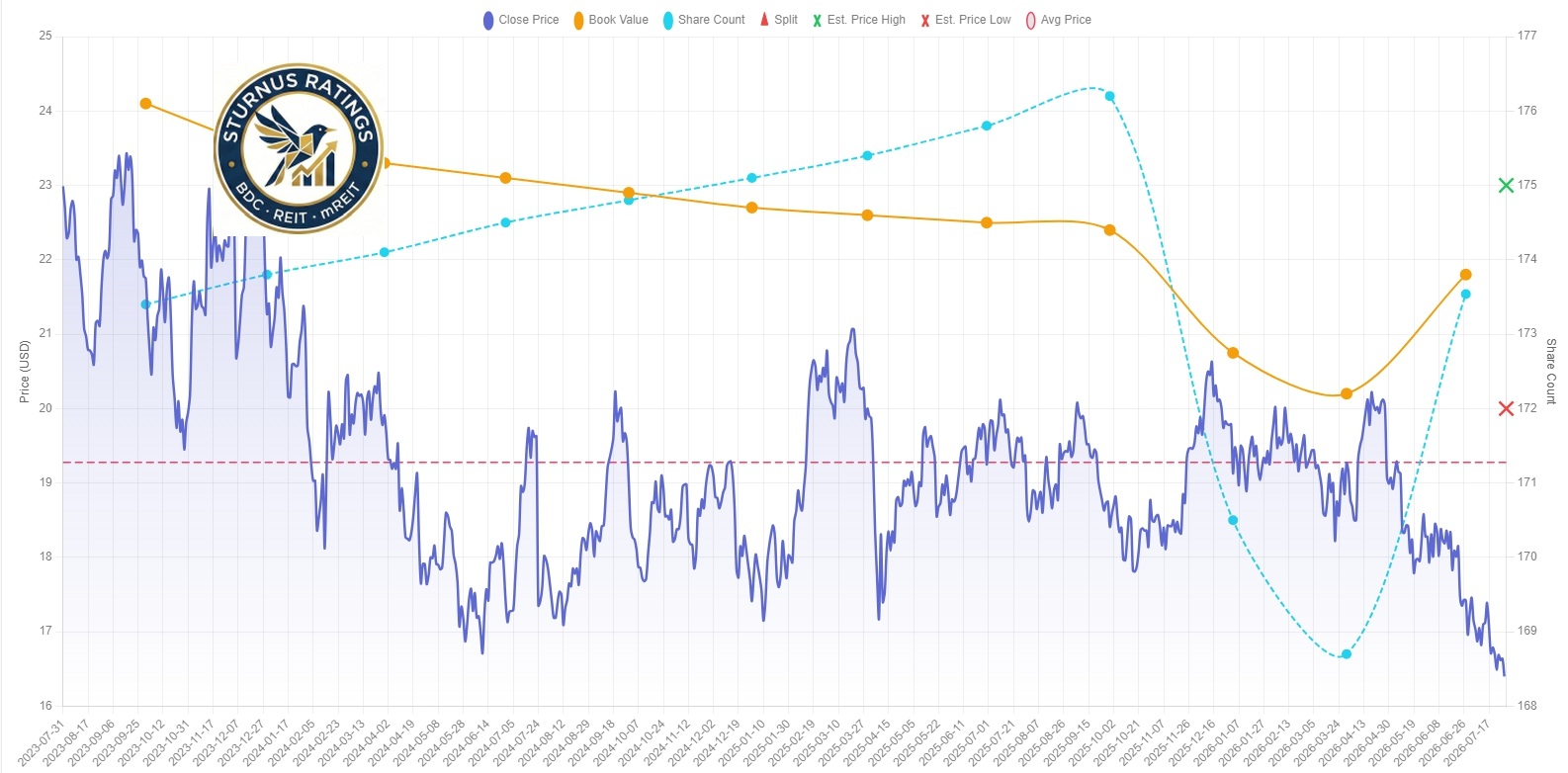
At the latest available July 29 close, BXMT traded at approximately $16.40.
Price
Recent Share Price Performance
Blackstone Mortgage Trust, Inc. has experienced a difficult multi-year period as the commercial real estate credit cycle deteriorated and investors became increasingly concerned about office exposure, loan losses and the sustainability of its dividend.
At approximately $16.40 per share on July 29, 2026, the stock was:
- about 14.6% below its level one year earlier;
- about 20.6% below the 52-week high of approximately $20.67;
- roughly $3.80 below its Q1 2026 reported BVPS of $20.20.
The recent share-price weakness therefore continues to reflect a significant discount to reported book value. This is not necessarily a sign that the market believes all of the company's assets are impaired. Rather, it indicates that investors are demanding a substantial margin of safety against the possibility that reported book value will ultimately prove too optimistic, particularly given the uncertainty surrounding commercial real estate valuations and loan recoveries.
Share Price Performance Relative to Book Value Trends
The most important metric for Blackstone Mortgage Trust, Inc. is arguably not GAAP EPS but the relationship between share price and economic book value.
At Q1 2026:
- BVPS: $20.20
- Share price: approximately $16.40
- Price/BV: approximately 0.81x
Thus, the market was valuing BXMT at approximately an 19% discount to reported book value. That discount is significant. However, I would not automatically interpret 0.81x BV as a bargain.
For a commercial mREIT, book value can be overstated when:
- loans are carried at amortized cost;
- collateral values have declined faster than expected;
- borrowers are temporarily current but economically stressed;
- refinancing risk has increased;
- office properties require additional equity injections;
- CECL reserves prove insufficient;
- loan extensions postpone rather than eliminate losses.
That is the central BXMT investment debate.
Price-to-Book Analysis
At approximately 0.81x Q1 2026 BVPS, BXMT trades at a meaningful discount to book value.
Historically, BXMT traded much closer to or above book value during periods when:
- commercial real estate credit was healthy;
- financing was inexpensive;
- loan originations were growing;
- credit losses were low;
- investors were confident in the Blackstone platform.
The current discount reflects a fundamentally different environment. My interpretation is: 0.81x BV is attractive if the majority of the existing CECL reserves and current marks adequately capture eventual credit losses. It is not attractive if office and other troubled loans ultimately require materially larger write-downs than currently recognized. The Q1 2026 results provide some reassurance: the company reported a 98% performing loan portfolio, stable weighted-average risk rating of 3.0, and four upgrades versus four downgrades during the quarter. However, the portfolio still contains meaningful legacy credit risk, and "performing" does not mean "risk-free."
Comparison with Relevant mREIT Peers
The most relevant peers are other commercial and diversified mortgage REITs, including:
- Starwood Property Trust, Inc.
- Ares Commercial Real Estate Corporation
- Apollo Commercial Real Estate Finance, Inc.
- Ladder Capital Corp
BXMT deserves a premium to weaker commercial mREITs because of the strength of the Blackstone platform, its access to capital and its ability to source large institutional-quality transactions. However, the stock should not trade at a large premium to peers until investors are confident that its legacy credit book can be resolved without substantial additional BVPS erosion. My relative valuation view: BXMT's discount is justified, but the current discount appears to price in a substantial amount of credit stress.
Key Factors Influencing Investor Sentiment
The most important factors are:
- Office loan exposure
- Credit migration and risk ratings
- Non-accrual loans
- CECL reserve adequacy
- Loan repayments and asset sales
- Recovery values on impaired loans
- Dividend coverage
- Funding costs and liquidity
- Commercial real estate transaction volumes
- Interest-rate expectations
The positive factor is that BXMT has a large institutional platform and access to Blackstone's broader real estate ecosystem. The negative factor is that commercial real estate credit problems can take years to resolve. A loan that is technically current today may still eventually require restructuring or a discounted payoff.
Market Expectations Reflected in the Current Share Price
I believe that is a reasonable interpretation. The market is not pricing BXMT as a distressed liquidation, but it is also clearly not assigning full confidence to management's reported BV.
That creates asymmetric potential:
- If credit losses remain contained, the discount can narrow substantially.
- If credit losses accelerate, BVPS could fall toward the share price—or below it.
Price assessment: Moderately undervalued, but only for investors willing to accept meaningful commercial real estate credit risk.
Dividend
Current Dividend Yield
Blackstone Mortgage Trust, Inc. declared a $0.47 per-share quarterly dividend for Q2 2026. At approximately $16.40 per share, that equates to: $1.88 annualized dividend ÷ $16.40 share price = approximately 11.5% forward yield. The dividend yield is therefore exceptionally high relative to most traditional REITs. The problem is that the yield is high because the market is skeptical about the durability of the underlying earnings and book value. The company has maintained the $0.47 quarterly dividend through 2026 so far.
Dividend History and Trend
BXMT's dividend history is an important warning. The company previously paid a substantially higher dividend of $0.62 per share quarterly, but the payout was reduced to $0.47. The reduction was a direct response to the changing commercial real estate environment and lower earnings power. This means the current $0.47 dividend should not be considered sacrosanct. Management has already demonstrated a willingness to reduce the payout when earnings and credit conditions deteriorate.
Distributable Earnings Coverage
Q1 2026 presents a nuanced picture.
Blackstone Mortgage Trust, Inc. reported:
- Distributable EPS: $0.21
- Distributable EPS before realized gains/losses: $0.49
- Dividend: $0.47
The headline coverage based on total Distributable EPS was therefore only: $0.21 ÷ $0.47 = approximately 45%
But that understates the recurring earnings capacity because realized gains and losses can distort the reported Distributable EPS measure.
Using Distributable EPS before realized gains and losses: $0.49 ÷ $0.47 = approximately 104% coverage
This is a much more constructive figure. However, I would still classify dividend coverage as thin rather than strong. There is almost no margin for error. A sustainable dividend for a commercial mREIT should ideally be covered by recurring distributable earnings with a meaningful buffer. BXMT's Q1 recurring coverage was only slightly above 100%.
Dividend Payout Ratio
On the recurring earnings measure: Dividend payout ratio ≈ $0.47 ÷ $0.49 = 96% This is high. It means essentially all recurring distributable earnings are being paid out.
The company therefore has limited internal capacity to:
- rebuild book value;
- absorb unexpected credit losses;
- increase reserves;
- fund growth.
The good news is that the dividend is approximately covered by recurring distributable earnings. The bad news is that the margin of safety is very small.
Dividend Safety and Sustainability
My assessment: Moderately risky / approximately covered
I would not describe the $0.47 dividend as unsafe today. But I also would not describe it as highly secure.
The key reasons are:
Positive
- recurring distributable earnings were approximately sufficient to cover the dividend;
- portfolio was 98% performing;
- risk rating remained stable;
- Blackstone provides significant institutional support;
- the company maintains substantial liquidity and financing access.
Negative
- coverage is thin;
- commercial real estate credit remains cyclical;
- office loans remain a structural risk;
- realized losses can materially affect distributable earnings;
- the dividend was already reduced from $0.62 to $0.47;
- the company is operating with a relatively high payout ratio.
Therefore, I would assign the dividend a medium risk rating, not a low risk rating.
Potential Catalysts for Dividend Increases or Reductions
Potential increase
A dividend increase would require:
- sustained distributable EPS comfortably above $0.47;
- declining credit costs;
- successful repayment of legacy loans;
- stable or rising BVPS;
- stronger commercial real estate transaction activity;
- lower financing costs.
I see little near-term probability of a dividend increase.
Potential reduction
The main triggers would be:
- additional large loan impairments;
- materially higher non-accruals;
- inadequate CECL reserves;
- further office deterioration;
- falling distributable earnings;
- prolonged high funding costs.
The dividend reduction risk is therefore real but not yet the base case.
Management's Dividend Outlook
The maintenance of the $0.47 dividend in 2026 indicates that management currently believes the payout remains supportable. This is fundamentally different from companies where earnings cover dividends by 120–130%.
Valuation
Current Price-to-Book Valuation
At:
- Share price: ~$16.40
- BVPS: $20.20
BXMT trades at approximately: 0.81x Price-to-Book
That is the strongest argument for owning the stock. The question is whether BVPS is conservative enough. Importantly, Q1 BVPS included $1.80/share of CECL reserves. Therefore, the company is already recognizing substantial expected credit losses in its accounting book value. This makes the current discount more interesting.
Historical Price-to-Book Comparison
BXMT has historically traded around or above book value during healthier credit cycles. The current ~0.81x multiple therefore represents a substantial compression.
However, I would not expect the stock to return to 1.1–1.2x BV until the market is confident that:
- the commercial property market has stabilized;
- office valuations have bottomed;
- loan repayments are accelerating;
- credit losses are peaking;
- financing markets are normalizing.
A return to 0.95–1.00x normalized BV is much more realistic than assuming a return to the historical premium immediately.
Book Value Per Share Trend
The BVPS trend is more important than the absolute BVPS number.
The 2026 data are cautiously encouraging:
- portfolio remained 98% performing;
- risk rating was stable;
- four loans were upgraded and four downgraded;
- the company continued to originate and refinance assets;
- liquidity remained strong.
But the legacy loan book still requires close monitoring. For BXMT, BVPS stability over the next four to six quarters would be a major bullish signal. A decline in BVPS caused by realized credit losses would be considerably more concerning than a temporary mark-to-market decline.
Economic Return Analysis
For an mREIT, economic return is: Dividend income + change in BVPS
At an annualized dividend of $1.88 and a $16.40 share price, the current dividend yield is approximately 11.5%. If BVPS remains stable, investors could theoretically earn a very attractive double-digit economic return. However, if BVPS declines by 10%, the dividend income could be largely offset.
For example:
- dividend return: ~11.5%
- BV decline: -10%
- approximate economic return: ~1.5%
This illustrates why BXMT should not be viewed simply as an 11.5%-yielding income stock.
Earnings Quality Assessment
I view earnings quality as mixed but improving. The recurring earnings engine remains attractive because BXMT primarily owns floating-rate commercial mortgage loans.
However, earnings are exposed to:
- credit provisions;
- realized losses;
- loan restructurings;
- non-accruals;
- funding costs.
The fact that Q1 Distributable EPS before realized gains/losses was $0.49 is encouraging, but the $0.21 reported Distributable EPS demonstrates how volatile bottom-line earnings can become.
This is why I would place greater emphasis on: recurring distributable earnings + BVPS trend + credit migration rather than GAAP EPS alone.
Portfolio Composition and Risk Profile
Blackstone Mortgage Trust, Inc. is fundamentally a senior commercial real estate lender. Its portfolio is concentrated in loans secured by commercial properties, with a large proportion in institutional-quality real estate. Q1 2026 reported that 98% of the loan portfolio was performing, while more than half was concentrated in residential and industrial sectors. The company also reported a portfolio of approximately $19.7 billion. The portfolio mix is important.
More attractive exposures
- industrial;
- data centers;
- residential/multifamily;
- logistics.
More problematic exposures
- traditional office;
- weaker hospitality;
- secondary-market commercial assets.
The company has been actively reducing problematic exposures through repayments and resolutions. That is positive. But the biggest risk is that the remaining troubled assets could consume several years of earnings through credit losses.
Leverage Analysis
Leverage is one of the primary risks.
Commercial mREITs use leverage to amplify returns on equity. This works extremely well when:
- loan spreads are high;
- credit losses are low;
- financing is stable.
It works against shareholders when:
- asset values decline;
- funding costs increase;
- collateral requirements rise;
- loans become non-performing.
BXMT's balance sheet has historically been more conservatively structured than many highly levered Agency mREITs, but its absolute leverage remains meaningful because the business is fundamentally a leveraged lending platform. The 2026 balance-sheet actions are encouraging. The company issued $450 million of senior secured notes, intending to use proceeds partly to repay existing secured indebtedness, while also refinancing and extending its financing structure. Q1 reporting also highlighted approximately $1 billion of liquidity and more than $9 billion of availability across 16 bank counterparties. This is one of BXMT's major advantages. Liquidity risk appears manageable at present; credit risk remains the larger concern.
Funding Costs and Interest-Rate Sensitivity
BXMT's portfolio is predominantly floating-rate.
That means:
Falling short-term rates
Positive:
- lower funding costs;
- potentially lower credit stress;
- improved borrower refinancing prospects.
Negative:
- lower loan yields;
- lower interest income.
The ultimate effect depends on the relative speed of asset-yield and funding-cost adjustments. Importantly, commercial borrowers with floating-rate loans can benefit from lower rates because debt-service burdens decline.
That can improve:
- debt-service coverage;
- refinancing prospects;
- property cash flows;
- loan repayment probabilities.
Therefore, moderately lower interest rates are probably positive for BXMT's credit quality, even if they reduce gross interest income.
Hedging Strategy Effectiveness
BXMT differs from Agency mREITs because it does not have the same duration and convexity exposure associated with large Agency MBS portfolios.
Its primary risk management focus is therefore:
- interest-rate hedging;
- liability management;
- matching financing duration;
- reducing exposure to sudden rate movements.
For BXMT, I would judge hedging effectiveness less by changes in GAAP BV and more by whether the company can maintain:
- stable net interest margins;
- predictable funding costs;
- manageable debt maturities.
The balance-sheet refinancing activity in 2026 is encouraging because liability management is itself an important form of risk management.
Impact of Federal Reserve Policy and Macro Conditions
The Federal Reserve maintained the federal funds target range at 3.50%–3.75% on July 29, 2026, with the decision passing 9–3. The Fed continues to describe inflation as elevated relative to its 2% objective. This is a mixed environment for BXMT.
Positive
A gradual decline in rates would:
- reduce borrower interest expense;
- improve property-level debt-service coverage;
- support refinancing;
- improve commercial real estate transaction volumes;
- potentially reduce loan default risk.
Negative
Rapid rate cuts caused by a recession could:
- reduce property values;
- increase unemployment;
- weaken tenant demand;
- increase loan defaults.
Therefore, the best scenario for BXMT is not aggressive Fed easing caused by recession. That combination could significantly improve BXMT's credit outlook. The Fed's current stance—rates unchanged while inflation remains elevated—does not provide an immediate catalyst, but the absence of additional tightening is helpful for commercial real estate borrowers.
Relative Valuation Versus Peer mREITs
BXMT deserves a higher valuation than the weakest commercial mREITs because of:
- Blackstone sponsorship;
- institutional loan sourcing;
- global scale;
- access to capital;
- financing diversification;
- stronger liquidity.
However, the stock deserves a discount to premium-quality mREITs until the market gains greater confidence in credit normalization. My approximate valuation framework is: ScenarioApprox. P/BInterpretationSevere credit deterioration0.60–0.70xSignificant downsideBear/base stress0.75–0.85xCurrent valuation zoneCredit stabilization0.90–1.00xMeaningful upsideStrong recovery1.05–1.15xHigh upside potential. These are my analytical valuation ranges, not company guidance or consensus estimates. At approximately 0.81x BV, I consider the shares modestly undervalued on a normalized book-value basis, but only if current CECL reserves are reasonably adequate and the portfolio avoids another major wave of commercial real estate impairments.
Conclusion
Key Strengths
1. Significant discount to book value
At approximately 0.81x Q1 2026 BVPS, BXMT is priced below reported net asset value.
2. High current dividend yield
The $0.47 quarterly dividend produces an annualized yield of approximately 11.5% at the recent share price.
3. Recurring earnings approximately cover the dividend
Q1 Distributable EPS before realized gains/losses was $0.49 versus a $0.47 dividend. Coverage is thin but currently adequate.
4. Strong institutional platform
Blackstone provides BXMT with advantages in sourcing, underwriting, asset management and financing.
5. Improving balance-sheet flexibility
The company has continued to diversify funding and maintain substantial liquidity.
Key Risks
1. Commercial real estate credit risk
This remains the single greatest risk.
2. Office exposure
Even though the portfolio is 98% performing, office loans can remain economically stressed before becoming formally non-performing.
3. Thin dividend coverage
A $0.49 recurring distributable EPS versus a $0.47 dividend leaves almost no margin of safety.
4. Potential BVPS erosion
If actual credit losses exceed current CECL assumptions, BVPS could fall materially.
5. Dividend-cut risk
The prior reduction from $0.62 to $0.47 demonstrates that the dividend is not untouchable.
6. Leverage
Leverage magnifies both positive and negative changes in asset performance.
Outlook for Book Value and Earnings
My base case is stabilization rather than rapid recovery.
I expect BVPS to remain volatile, but the most important potential inflection point would be a sustained period in which:
- loan repayments exceed new problem loans;
- risk ratings improve;
- CECL reserves decline;
- office exposure continues to shrink;
- credit losses remain below expectations.
If that occurs, the current discount to BV could narrow considerably.The biggest risk is that the apparent stability in BVPS proves temporary and additional credit losses emerge as loans mature or require refinancing.
Outlook for Dividend Sustainability
Dividend rating: MODERATELY SAFE, BUT LOW MARGIN OF SAFETY
The current $0.47 dividend appears approximately covered by recurring distributable earnings. I do not expect an immediate dividend cut to be the base case.
However, I would not assign the dividend a "highly safe" rating because:
- coverage is close to 100%;
- commercial real estate credit remains uncertain;
- the company has already reduced its dividend historically;
- realized losses can quickly affect distributable earnings.
The probability of a future dividend cut would increase materially if recurring Distributable EPS fell below approximately $0.45 for multiple quarters or if credit losses accelerated.
Expected Impact of Management Guidance and Federal Reserve Policy
The most important management indicators to monitor are:
- BVPS stabilization
- Loan risk-rating migration
- CECL reserve changes
- Non-accrual trends
- Realized credit losses
- Dividend coverage
- Loan repayments
- Office exposure reduction
The Fed's current policy is neither strongly bullish nor bearish. A gradual decline in rates without a recession would be the most favorable environment for BXMT because it could improve borrower debt-service coverage and refinancing conditions. The July 29 decision to maintain rates at 3.50%–3.75% means that immediate monetary easing is not yet providing a strong catalyst.
Near-Term and Long-Term Outlook
Near term: Neutral to cautiously bullish
The 0.81x P/B valuation and approximately 11.5% dividend yield offer substantial income and valuation support. But the upcoming earnings results are critical. The market needs evidence that recurring earnings can consistently cover the dividend while BVPS stabilizes.
Long term: Potentially attractive, but highly dependent on credit normalization
If BXMT successfully resolves its legacy commercial real estate problems without major additional BV erosion, the stock could deliver an attractive combination of:
- ~11% current income;
- P/B multiple expansion;
- BVPS stabilization;
- eventual dividend recovery.
If credit losses are materially worse than current reserves imply, however, the apparent 19% discount to book value could prove to be a value trap.
Investment Thesis
Rating: SPECULATIVE BUY / HIGH-RISK INCOME
I consider Blackstone Mortgage Trust, Inc. one of the more interesting contrarian opportunities in the commercial mREIT sector, but I would not classify it as a low-risk high-yield investment.
The valuation is compelling:
- ~0.81x BVPS
- ~11.5% forward dividend yield
- ~104% recurring distributable earnings coverage
The fundamental issue is that the discount to book value and high yield exist for a reason: investors remain concerned that commercial real estate credit losses could ultimately be larger than currently reflected in book value. I would therefore classify the stock as undervalued on normalized book value, but with a high degree of credit-cycle risk. For a long-term income investor, I see more upside than downside at ~$16.40, but the position should be sized as a high-risk commercial credit investment, not as a bond substitute. The single most important metric to watch from here is not the dividend yield—it is the trajectory of BVPS after credit losses. If BVPS stabilizes around $20 while recurring distributable earnings remain at or above $0.47 per quarter, the current valuation looks attractive. If BVPS falls toward $17–18 because of additional credit losses, today's apparent 0.81x P/B discount may turn out to have been entirely justified.
Comments (0)
Log in to leave a comment.
No comments yet. Be the first to comment!