Agree Realty Corporation is a net-lease retail REIT focused primarily on acquiring and developing properties leased to high-quality retailers under long-term, generally triple-net leases. The company's portfolio is particularly notable for its concentration in investment-grade and nationally recognized retail tenants, its substantial exposure to essential-goods and service-oriented businesses, and its disciplined external-growth model. The main question is valuation. At the current share price, I believe ADC is a high-quality REIT trading around fair value, with the potential for attractive long-term total returns but without a particularly large margin of safety.
Price
Agree Realty Corporation has historically been viewed as a high-quality net-lease REIT because of the predictability of its cash flows. The company's business model is based primarily on long-term leases, which means that near-term earnings are less sensitive to economic cycles than those of many other real estate sectors.
However, the stock remains sensitive to:
- Treasury yields;
- credit spreads;
- acquisition cap rates;
- tenant credit quality;
- and the relative attractiveness of its dividend yield.
The share price therefore tends to perform best when long-term interest rates decline or stabilize.
Recent share price performance
Agree Realty's shares have recently traded in the mid-$70s, with the stock benefiting from improving sentiment toward high-quality net-lease REITs and expectations for a more favorable interest-rate environment.
The stock's performance has been supported by:
- consistent AFFO growth;
- regular dividend increases;
- continued acquisition activity;
- and the market's preference for high-quality contractual cash flows.
However, the stock is not a high-growth investment. The fundamental return profile is more likely to come from: dividend income + 3–5% AFFO/share growth + modest valuation changes rather than from explosive earnings growth. That makes the entry valuation particularly important.
Q2 2026 operating performance
The Q2 2026 results reinforced the core strengths of Agree Realty's business model.
The company continued to demonstrate:
- high occupancy;
- strong rent collection;
- a diversified tenant base;
- positive contractual rent growth;
- and ongoing external investment activity.
The most important metric for ADC remains AFFO per share, because the company's dividend is ultimately supported by recurring cash flow generated by the property portfolio.
Agree Realty's business is relatively predictable because most leases contain:
- long contractual terms;
- fixed annual rent escalators;
- and tenant responsibility for property-level expenses.
This creates a relatively stable cash-flow profile.
Key catalysts affecting the share price
1. Interest rates
Interest rates remain the most important macroeconomic catalyst. Agree Realty's valuation is particularly sensitive to long-term Treasury yields because investors often compare the company's dividend yield with the yield available on:
- U.S. Treasuries;
- investment-grade corporate bonds;
- and other income-producing assets.
If long-term rates decline, ADC could benefit through:
- lower cost of debt;
- improved acquisition spreads;
- higher property valuations;
- and multiple expansion.
If rates remain elevated, the stock's valuation may remain constrained. The key issue is that ADC's external growth depends on the spread between: property acquisition yields and cost of capital. When the cost of capital falls, the company can potentially acquire more properties at attractive spreads. This is particularly important for a REIT whose growth strategy depends heavily on acquisitions.
2. Acquisition volume
External growth is central to Agree Realty's investment thesis. The company has historically invested heavily in acquiring single-tenant retail properties, often with long lease terms and built-in rent escalators.
The ideal acquisition has:
- a strong tenant;
- a long remaining lease term;
- a favorable location;
- annual contractual rent increases;
- and an acquisition cap rate sufficiently above ADC's weighted average cost of capital.
If ADC can continue to acquire properties at attractive spreads, AFFO per share should continue to grow. However, there is a natural constraint. When high-quality net-lease properties become expensive, acquisition cap rates compress. That makes it more difficult to generate attractive incremental returns. Therefore, I would not judge ADC's management simply by the amount of acquisitions completed.
3. Development platform
Agree Realty has an additional growth engine through its development program. Development can potentially generate higher yields than acquisitions because the company creates the real estate itself rather than purchasing fully stabilized properties. The risk is greater execution complexity.
Development requires:
- construction capital;
- tenant commitments;
- careful site selection;
- and control of construction costs.
The best-case scenario is that ADC develops properties for high-quality tenants at attractive yields and then retains the assets as long-term investments.
This can create value if development yields exceed:
- the company's cost of debt;
- its cost of equity;
- and the implied yield available from purchasing stabilized properties.
4. Tenant quality
Tenant quality is a critical component of ADC's valuation. The company focuses heavily on large national retailers and investment-grade tenants.
This provides several advantages:
- lower probability of rent default;
- better access to capital;
- greater resilience during recessions;
- and stronger residual property value.
However, the retail sector is not risk-free.
Even large retailers can experience:
- changing consumer preferences;
- e-commerce competition;
- margin pressure;
- and store closures.
The quality of the real estate is therefore as important as the credit quality of the tenant. A strong tenant occupying a weak location can still create long-term risk. ADC's focus on necessity-oriented and service-based retail properties helps mitigate this risk.
5. Retail real estate fundamentals
The retail real estate environment has changed substantially over the past decade.
The strongest retail properties today tend to be:
- grocery-anchored;
- necessity-based;
- service-oriented;
- experiential;
- or difficult to replicate.
Single-tenant properties leased to major retailers can also perform well when the tenant occupies a strategically important location. Agree Realty's portfolio benefits from this structural shift. The key advantage is that the company is not primarily exposed to traditional enclosed malls or highly discretionary retail. That reduces, but does not eliminate, cyclical risk.
Technical and fundamental factors influencing market sentiment
The market generally views Agree Realty as a high-quality, defensive growth-and-income REIT.
The positive sentiment is driven by:
- strong occupancy;
- long lease durations;
- high-quality tenants;
- recurring contractual rent increases;
- and a long record of dividend growth.
The main negative factor is valuation.
Investors are willing to pay a premium for ADC's quality, but the premium can compress when:
- Treasury yields rise;
- acquisition spreads narrow;
- or AFFO growth slows.
Therefore, the stock's risk profile is relatively unusual. The business itself is comparatively defensive. The stock price, however, can still be volatile because the market constantly reprices the value of long-duration contractual cash flows.
Dividend
The dividend is arguably the central reason many investors own Agree Realty Corporation. ADC has built a reputation as a reliable dividend-growth REIT. The company currently pays approximately $0.79 per share per quarter, equivalent to approximately: $3.16 annualized
At a share price around $75–76, this corresponds to a forward dividend yield of approximately: 4.2%
This is a respectable yield for a high-quality net-lease REIT. More importantly, the dividend has historically grown consistently.
Dividend history and growth trends
Agree Realty has increased its monthly dividend repeatedly over the years, establishing itself as a consistent dividend-growth company.
The monthly dividend structure is particularly attractive for income investors because it provides:
- more frequent cash distributions;
- slightly faster compounding when reinvested;
- and a predictable income stream.
The key advantage is that ADC's dividend growth does not depend on aggressive rent increases.
Instead, dividend growth comes from:
- contractual rent escalators;
- acquisitions;
- development;
- and capital recycling.
That is a relatively conservative growth model. I believe investors should expect low-to-mid-single-digit long-term dividend growth, rather than double-digit increases. That is appropriate for a mature net-lease REIT.
AFFO payout ratio and dividend coverage
Agree Realty's dividend is well covered by recurring AFFO. Using a forward AFFO estimate in the vicinity of $4.10–$4.20 per share and an annualized dividend of approximately $3.16, the implied AFFO payout ratio is approximately: 75–77%
This is a reasonable payout ratio for a net-lease REIT. It leaves approximately: 23–25% of AFFO available for:
- retained capital;
- debt reduction;
- development;
- and equity investment.
The important point is that ADC's payout ratio is high enough to provide shareholders with a meaningful yield but low enough to retain a reasonable amount of internally generated capital.
I consider the dividend well covered.
Dividend safety
Dividend safety: VERY HIGH
Agree Realty's dividend is supported by:
- long-term leases;
- high occupancy;
- strong tenant quality;
- diversified rent sources;
- contractual rent escalators;
- and a reasonable AFFO payout ratio.
The company's net-lease model also means that tenants typically bear many property-level expenses. This creates relatively stable property-level cash flow. I see a low probability of a dividend cut under normal economic conditions. The more likely risk is not a reduction in the dividend. It is simply slower dividend growth if acquisition activity slows.
Potential risks to future dividend payments
1. Tenant defaults
A recession could increase tenant bankruptcies. However, ADC's diversified tenant base and emphasis on high-quality tenants reduce this risk.
2. Retail disruption
Long-term structural changes in retail could affect property values.
3. Interest rates
Higher rates can increase refinancing costs and reduce valuation multiples.
4. Acquisition spreads
If acquisition cap rates fall too low, external growth may become less accretive.
5. Equity dilution
If ADC issues shares at an unattractive valuation to fund acquisitions, AFFO per share growth could suffer. Overall, I believe the dividend is very safe.
Valuation
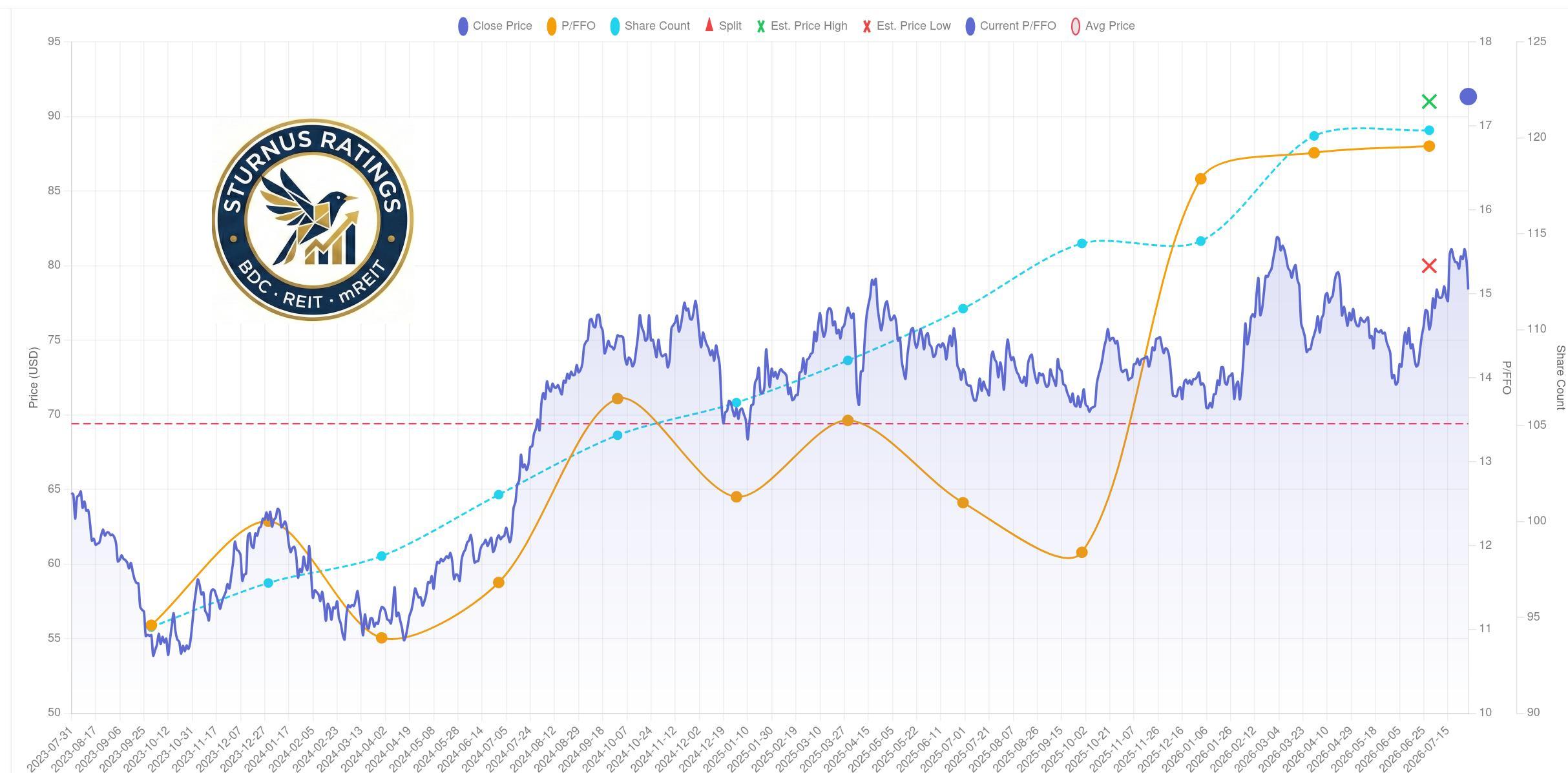
Price-to-FFO and Price-to-AFFO
At approximately $75–76 per share and estimated forward AFFO of roughly $4.10–$4.20, ADC trades at approximately: 18–19x forward AFFO
That is not a bargain.
However, the premium is justified to some extent by:
- high-quality tenants;
- long lease durations;
- strong balance sheet;
- consistent dividend growth;
- and a relatively low-risk portfolio.
The key issue is that ADC's growth rate is not high enough to justify an unlimited premium. If AFFO grows at approximately 4–5% annually and the dividend yield is around 4%, investors could reasonably expect long-term total returns in the high-single-digit range before valuation changes. That is attractive. But if the valuation multiple contracts from 19x AFFO to 16–17x, several years of dividend growth could be offset. Therefore, valuation remains important.
Historical valuation range
Agree Realty has historically commanded a premium valuation because of its quality and dividend-growth profile. However, the stock's multiple is highly sensitive to interest rates.
When Treasury yields rise:
- ADC's dividend yield becomes less competitive;
- its cost of capital increases;
- and its AFFO multiple tends to compress.
When rates fall:
- ADC becomes more attractive;
- acquisition spreads improve;
- and valuation can expand.
I therefore view the stock's historical valuation range as highly dependent on the interest-rate regime. At approximately 18–19x forward AFFO, the stock appears to be trading around the upper half of a reasonable long-term valuation range.
NAV considerations
NAV is important for ADC because the company owns high-quality, relatively liquid single-tenant retail properties.
The value of these properties depends on:
- tenant credit quality;
- lease duration;
- annual rent escalators;
- location;
- and market cap rates.
Long lease durations can create a double-edged sword. The positive is predictable income. The negative is that fixed rents may lag market rents if inflation rises rapidly. ADC's contractual rent escalators partially mitigate this risk. The company's NAV is also highly sensitive to interest rates. If cap rates decline: NAV rises. If cap rates rise: NAV falls. At current rates, I believe ADC's shares are trading at a modest premium to NAV, which is reasonable given the quality of the portfolio and the value of the company's operating platform. However, the premium limits the margin of safety.
Balance sheet quality, leverage, and debt profile
The balance sheet is a significant strength.
Agree Realty has historically maintained:
- investment-grade credit ratings;
- manageable leverage;
- diversified debt maturities;
- and substantial liquidity.
The company's net-lease business also generates relatively predictable cash flow, which supports debt service. The key metric I would monitor is: Net debt / EBITDAre. I generally consider the mid-5x range manageable for a high-quality net-lease REIT, while a sustained move significantly above that level would increase risk. The balance sheet appears sufficiently strong to support continued acquisitions without creating excessive financial risk. That is important because external growth is central to the ADC model.
Impact of interest rates and macroeconomic conditions
Agree Realty's performance is strongly influenced by the interest-rate cycle.
Lower rates
Positive for:
- valuation;
- refinancing;
- acquisitions;
- NAV;
- and dividend attractiveness.
Higher rates
Negative for:
- cost of capital;
- acquisition spreads;
- valuation multiples;
- and NAV.
However, ADC's contractual rent escalators provide some inflation protection. The company also benefits from the fact that many of its tenants sell essential products and services. This makes the portfolio relatively defensive during economic downturns. The most important macroeconomic variable for ADC's share price is therefore interest rates. The most important variable for ADC's underlying business is tenant health and the availability of attractive acquisition opportunities.
Valuation assessment
At approximately $75–76 per share, I consider Agree Realty Corporation: FAIRLY VALUED
My approximate valuation framework would be:
- Below $65: Strong Buy
- $65–72: Attractive
- $72–80: Fair value
- Above $80: Increasingly expensive
These are valuation zones rather than precise price targets.
At $75–76, the stock offers:
- approximately 4.2% dividend yield;
- roughly 18–19x forward AFFO;
- and potential 4–5% long-term AFFO growth.
That can produce attractive long-term returns.
However, I would prefer a larger margin of safety.
A share price in the $65–70 range would provide a substantially better combination of:
- dividend yield;
- AFFO valuation;
- and potential capital appreciation.
Conclusion
Key strengths
Agree Realty Corporation is one of the highest-quality net-lease REIT businesses.
Its key advantages include:
- long-term contractual leases;
- high occupancy;
- strong tenant quality;
- diversified rent sources;
- built-in rent escalators;
- low property-level operating expense exposure;
- strong balance sheet;
- and consistent dividend growth.
The business model is highly predictable. That predictability is particularly valuable for investors seeking a combination of: income + moderate growth + lower operating volatility.
Key risks
The main risks are:
- rising interest rates;
- valuation compression;
- tenant bankruptcies;
- retail disruption;
- acquisition cap-rate compression;
- and potential equity dilution.
The most important risk today is valuation. ADC is a good business, but the market knows it. The stock therefore rarely trades at a deeply discounted valuation unless there is significant pressure on interest rates or broader equity markets.
Near-term outlook
My near-term outlook is neutral to moderately bullish. The company's operating model remains strong, and the dividend appears secure.
The key near-term catalysts are:
- lower long-term Treasury yields;
- improving acquisition spreads;
- continued AFFO growth;
- continued monthly dividend increases;
- and accretive external investments.
If interest rates decline, ADC could benefit from both: lower financing costs and multiple expansion. That would be a powerful combination.
Long-term outlook
My long-term outlook is bullish. The long-term investment case rests on a relatively simple compounding mechanism: Acquire high-quality properties → lock in long leases → collect predictable rent → reinvest capital → grow AFFO → increase dividend → repeat. The model is not exciting. That is precisely its advantage. The biggest risk is that investors pay too much for the predictability. At the right valuation, however, the combination of:
- approximately 4%+ starting yield;
- 4–5% AFFO growth;
- and long-term dividend increases
can generate attractive high-single-digit total returns.
Investment Thesis
Overall rating: BUY / ACCUMULATE ON WEAKNESS
Agree Realty Corporation is a high-quality, defensive net-lease REIT with an attractive combination of dividend safety and moderate long-term growth. At approximately $75–76 per share, I believe the shares are fairly valued rather than deeply undervalued.
The current valuation is justified by:
- strong tenant quality;
- long lease duration;
- high occupancy;
- predictable cash flows;
- a strong balance sheet;
- and a proven dividend-growth strategy.
I would prefer to buy aggressively closer to $65–70, where the dividend yield would move toward the 4.5–5% range and the AFFO multiple would provide a better margin of safety. Thesis is that ADC is a stock to compound, not a stock to trade. An investor buying at a reasonable valuation can potentially earn attractive long-term returns through a combination of a growing 4%+ dividend yield and mid-single-digit AFFO-per-share growth. The business itself has relatively low fundamental risk, but the stock remains vulnerable to interest-rate-driven multiple compression. The most important metric I would monitor is AFFO per share growth relative to the cost of capital. If ADC continues to acquire and develop properties at spreads that exceed its weighted average cost of capital, the company can continue compounding intrinsic value and dividends. If acquisition yields compress while interest rates remain elevated, external growth will slow—but the underlying portfolio should remain resilient.
Agree Realty Corporation remains an attractive long-term dividend-growth REIT. The dividend is well covered, the portfolio is defensive, and the business model is highly predictable. At the current valuation, I would be comfortable owning the shares for the long term, but I would prefer to increase the position materially during a market correction or interest-rate-driven selloff rather than chase the stock at the upper end of its historical valuation range.
Comments (0)
Log in to leave a comment.
No comments yet. Be the first to comment!