Price
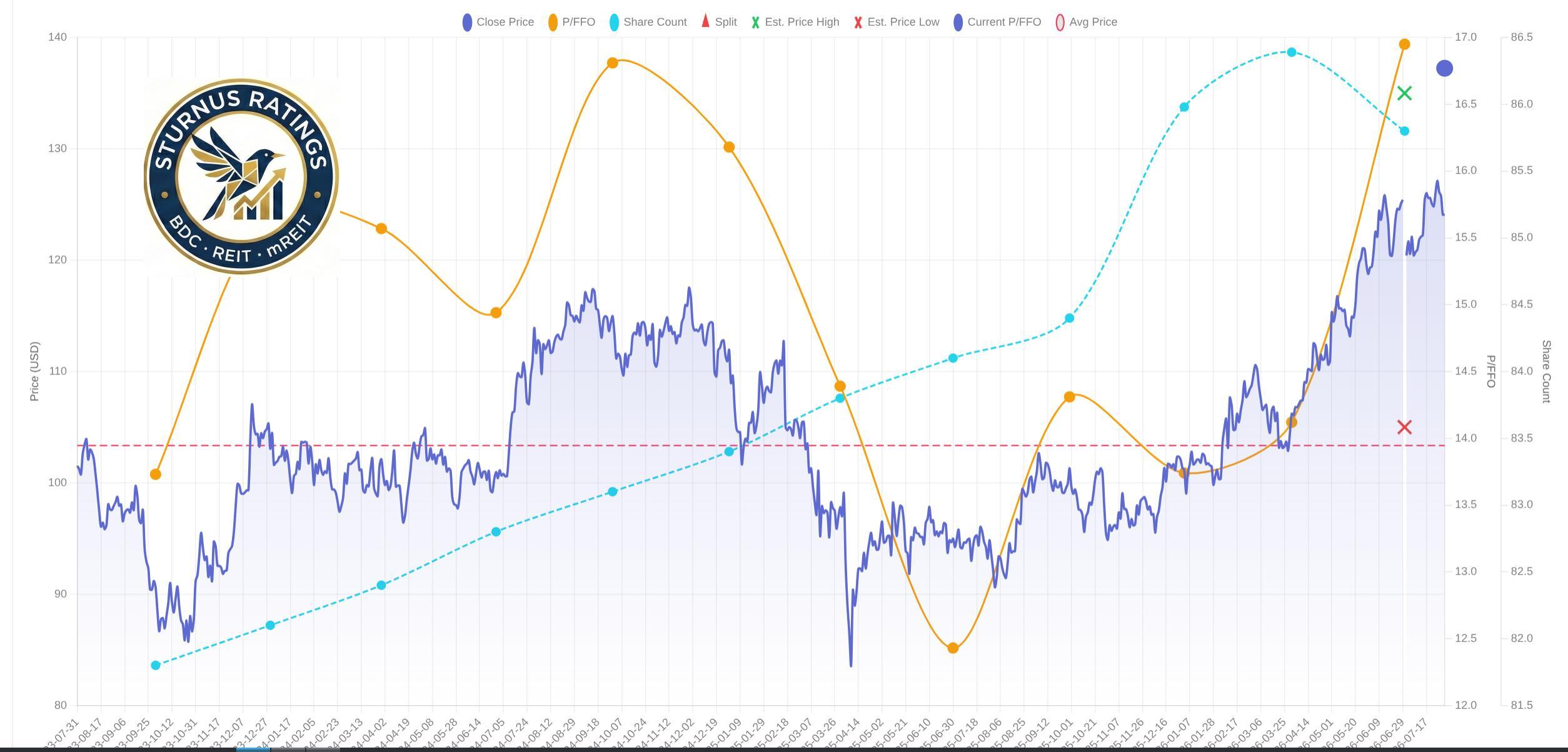
Federal Realty Investment Trust is one of the highest-quality shopping-center REITs in the U.S., with a portfolio concentrated in affluent, supply-constrained markets. The company owns 104 properties encompassing approximately 29.0 million commercial square feet, around 3,800 tenants and approximately 2,500 residential units. Its portfolio includes major mixed-use destinations such as Santana Row, Pike & Rose and Assembly Row. This positioning gives Federal Realty Investment Trust a fundamentally different risk profile from lower-quality shopping-center owners with greater exposure to weaker demographics or secondary markets. The stock closed at $124.09 on July 30, 2026, after reaching a 52-week high of $128.21 on July 28. At the July 30 close, the shares were therefore only about 3.2% below their 52-week high. The recent share-price performance indicates that investors have already recognized much of the improvement in the retail real-estate environment and Federal Realty Investment Trust's strong operating fundamentals. The recent rally is particularly notable because it occurred despite the Federal Reserve maintaining the federal funds target range at 3.50%-3.75%. The Fed's July 2026 Monetary Policy Report stated that inflation remains above the 2% target, while economic activity continues to expand at a solid pace. For REITs, this creates a mixed environment: economic growth supports tenant sales and occupancy, but relatively high interest rates continue to constrain valuation multiples and financing costs. Relative to direct retail REIT peers, Federal Realty Investment Trust has recently demonstrated strong market performance. On July 30, its shares declined 1.34% to $124.09, outperforming Realty Income Corp., Kimco Realty Corp., and Regency Centers Corp. on that particular session. This is only a short-term comparison, but it reflects the market's willingness to pay a premium for Federal Realty Investment Trust's combination of high-quality assets, affluent demographics and long-term operating history.
Key catalysts for the share price
The principal positive catalyst is the company's embedded organic growth opportunity. Federal Realty Investment Trust entered 2026 with initial guidance for comparable-property growth of 3.0%-3.5%, while expected 2026 Nareit FFO and Core FFO were both projected at $7.42-$7.52 per diluted share. That represented projected Nareit FFO growth of approximately 2.8%-4.2% versus $7.22 in 2025, while Core FFO growth was projected at approximately 5.1%-6.5% versus $7.06 in 2025. The second major catalyst is Federal Realty Investment Trust's redevelopment pipeline. The company has highlighted a roughly $400 million resi-over-retail pipeline, which provides an opportunity to increase the density and productivity of existing properties rather than relying solely on external acquisitions. This is strategically important because redevelopment can generate higher returns on capital while strengthening already successful mixed-use destinations. A third catalyst is the potential for lower interest rates. If inflation moderates sufficiently for the Federal Reserve to reduce rates, high-quality REITs could benefit from lower financing costs, improved transaction economics and lower required equity yields. However, the timing of such a catalyst remains uncertain because the Fed's latest available policy assessment still described inflation as elevated. The main negative catalyst is valuation. At approximately $124 per share, the stock is trading close to its recent 52-week high. Consequently, the market is already pricing in a significant degree of operational stability and future growth. Any disappointing leasing results, weaker guidance or higher-than-expected financing costs could therefore have a disproportionate impact on the share price. Price assessment: The fundamental story remains strong, but the recent price appreciation has reduced the margin of safety. Federal Realty Investment Trust now looks more like a high-quality REIT trading near fair value than a deeply discounted recovery opportunity.
Dividend
Federal Realty Investment Trust's dividend remains one of its strongest investment characteristics.
The company currently pays a quarterly dividend of $1.13 per common share, equivalent to an indicated annual dividend of $4.52 per share. At the July 30 closing price of $124.09, that corresponds to a forward dividend yield of approximately 3.64%. The dividend record is exceptional. Federal Realty Investment Trust has increased its quarterly dividend for 58 consecutive years, according to the company's latest corporate disclosure, giving it the longest dividend-growth record in the REIT industry. The quarterly dividend increased from $1.10 in 2025 to $1.13 in 2026, a rise of approximately 2.7%. This is an important distinction: Federal Realty Investment Trust is not primarily a high-yield REIT. Its investment proposition is based on a combination of moderate current income, exceptionally long dividend history, capital appreciation potential and long-term dividend growth.
Dividend coverage
Using 2026 Core FFO guidance of $7.42-$7.52 per share, the annualized $4.52 dividend implies a Core FFO payout ratio of approximately 60.1%-60.9%. That is a healthy level of coverage for a high-quality retail REIT. It leaves roughly 39%-40% of projected Core FFO available for retained cash flow, debt reduction, redevelopment and other capital requirements before considering additional adjustments. However, investors should distinguish between FFO payout coverage and AFFO payout coverage. Federal Realty Investment Trust's reported FFO is not equivalent to free cash flow because recurring maintenance capital expenditures and other adjustments must be considered. The company's supplemental reporting is therefore important when assessing the true long-term dividend coverage. Even so, the available 2026 FFO guidance provides a substantial margin of safety. The current dividend of $4.52 represents only about 60% of the midpoint of projected Core FFO of $7.47. That is a materially safer payout profile than the coverage ratios seen at many REITs operating with substantially higher leverage or weaker property fundamentals.
Dividend safety
My assessment is that the dividend is very safe under normal operating conditions.
The main reasons are:
- exceptionally long dividend-growth history;
- high-quality properties in affluent markets;
- strong tenant diversification;
- high occupancy and leasing demand;
- substantial embedded redevelopment opportunities;
- moderate FFO payout ratio;
- access to capital markets;
- and a business model that has historically generated relatively resilient recurring cash flows. The key risk is not an imminent dividend cut. Rather, the greater risk is that dividend growth remains modest if interest costs remain elevated and management prioritizes balance-sheet flexibility and redevelopment investment. The company's dividend history is particularly persuasive here. A 58-year record does not guarantee future increases, but it demonstrates an unusually strong institutional commitment to maintaining and growing the common distribution through multiple economic and real-estate cycles.
Dividend assessment: Very safe and sustainable, with the most likely long-term outcome being continued low-single-digit dividend growth rather than rapid increases.
Valuation
At $124.09, Federal Realty Investment Trust trades at approximately:
- 16.6x 2026 midpoint Core FFO of $7.47;
- 16.5x 2026 high-end Core FFO of $7.52;
- 16.7x 2026 low-end Core FFO of $7.42;
- approximately 3.64% forward dividend yield.
These calculations use the July 30 closing price and the company's 2026 FFO guidance. A multiple in the mid-teens is not obviously cheap for a shopping-center REIT, but Federal Realty Investment Trust deserves a valuation premium relative to lower-quality peers because of its:
- superior locations;
- high barriers to entry;
- affluent customer demographics;
- strong tenant demand;
- redevelopment expertise;
- mixed-use development platform;
- long dividend-growth history;
- relatively defensive portfolio characteristics.
The key question is therefore not whether Federal Realty Investment Trust deserves a premium—it clearly does—but how large that premium should be. Compared with companies such as Realty Income Corp., Kimco Realty Corp. and Regency Centers Corp., Federal Realty Investment Trust generally offers a stronger combination of high-quality coastal real estate and redevelopment potential, but its valuation must be justified by superior long-term FFO growth and balance-sheet strength. A premium valuation is reasonable; an excessive premium would limit future total returns.
NAV considerations
NAV is particularly important for Federal Realty Investment Trust because the company owns a substantial portfolio of high-quality real estate in supply-constrained markets. The major challenge is that private-market NAV is difficult to estimate precisely. The value of Federal Realty Investment Trust's properties depends heavily on capitalization rates, market rents, redevelopment potential and the valuation of mixed-use assets. The company's assets may therefore be worth materially more than a simple book-value calculation would imply. At the same time, the stock's recent rally toward $128 means that investors should not assume a large NAV discount without performing a detailed property-level valuation. The appropriate approach is to calculate NAV using market capitalization rates for the company's major metropolitan markets, adjust for redevelopment value and residential components, and subtract net debt and other liabilities. Without the complete Q2 2026 supplemental package available, I would not assign a precise current NAV estimate here because doing so would risk presenting an artificially precise figure unsupported by the latest property-level data.
Balance sheet and debt
Balance-sheet quality is a critical consideration for a REIT in the current interest-rate environment. Federal Realty Investment Trust's primary risk is not property-level demand but the cost of capital required to refinance debt and fund its redevelopment pipeline. The company's 2026 guidance explicitly incorporates significant redevelopment and expansion activity, including $175-$225 million of development and redevelopment capital and $13-$15 million of incremental redevelopment/expansion profit contribution. This illustrates both the opportunity and the capital requirements of the strategy. The interest-rate environment remains a headwind. The Federal Reserve has maintained the federal funds rate at 3.50%-3.75%, while inflation remains above target. Higher-for-longer rates can affect Federal Realty Investment Trust through:
- higher refinancing costs;
- higher capitalization rates;
- lower property valuations;
- higher required equity returns;
- slower acquisition activity;
- and potentially wider credit spreads.
The positive side is that Federal Realty Investment Trust's high-quality assets and strong operating profile should provide better access to financing than weaker REITs. The company is also better positioned to absorb temporary increases in interest expense because its underlying property cash flows are relatively defensive.
Historical and peer valuation
The stock's approximately 16.6x forward Core FFO valuation does not represent a distressed valuation. It is consistent with the market assigning a premium to a high-quality shopping-center REIT. The critical issue is that the current valuation leaves less room for execution mistakes.
At this price, investors are effectively betting on:
- continued high occupancy;
- positive leasing spreads;
- sustained same-property NOI growth;
- successful redevelopment;
- manageable refinancing costs;
- and eventual normalization of interest rates.
If these assumptions hold, the current valuation is reasonable. If interest rates remain structurally high and FFO growth stays near the lower end of guidance, total returns could be constrained by multiple compression.
Valuation conclusion
Federal Realty Investment Trust appears approximately fairly valued to modestly overvalued at $124-$125 per share. I would not characterize the stock as expensive in the context of its asset quality. However, the shares no longer offer the kind of valuation discount that would provide a large margin of safety. The most attractive entry points would likely occur during periods when rising Treasury yields or broad REIT-sector weakness temporarily push the stock materially below its intrinsic value. Conversely, buying aggressively near the recent 52-week high requires confidence that FFO growth will accelerate beyond the current guidance trajectory.
Conclusion
Federal Realty Investment Trust remains one of the highest-quality retail-focused REITs available to long-term investors. Its greatest competitive advantage is the quality of its real estate. The company focuses on high-income, supply-constrained markets where new competing retail developments are difficult to build. Its portfolio also benefits from mixed-use projects that combine retail, residential and office components, creating destinations that can generate stronger customer traffic and potentially higher long-term property values. The company's dividend is another major strength. The 58 consecutive years of dividend increases are an extraordinary achievement, and the current payout appears well supported by projected 2026 Core FFO. Based on the company's $7.42-$7.52 Core FFO guidance and $4.52 annualized dividend, the implied Core FFO payout ratio is approximately 60%-61%, leaving a meaningful cushion. The redevelopment pipeline is also attractive. Federal Realty Investment Trust has an opportunity to create additional value through densification of existing properties, including its resi-over-retail strategy. This could provide a valuable source of long-term growth without requiring the company to depend entirely on acquisitions at potentially unattractive cap rates. The principal weakness is valuation. At approximately 16.6x expected 2026 Core FFO and a roughly 3.6% forward dividend yield, the market is already assigning significant value to the company's high-quality assets and dividend record. The stock is also trading close to its 52-week high, limiting the immediate valuation cushion. The second major risk is interest rates. The Federal Reserve's current 3.50%-3.75% policy rate and still-elevated inflation mean that the interest-rate tailwind many REIT investors are waiting for has not yet fully materialized. A prolonged period of elevated rates could keep pressure on REIT valuation multiples and increase refinancing costs.
Investment thesis
Federal Realty Investment Trust is a high-quality, dividend-growth REIT with a very strong underlying business, but at around $124 per share I view the stock as closer to fairly valued than significantly undervalued. For a long-term income investor, the company's dividend safety, exceptional dividend-growth record, high-quality real estate and redevelopment pipeline make it attractive as a core REIT holding. However, the current yield is relatively modest, and the valuation does not provide a substantial margin of safety.
Overall assessment is therefore:
I would classify Federal Realty Investment Trust as a high-quality REIT that is worth owning for the long term, but not a clear bargain at the current share price. The strongest total-return opportunity would likely emerge from a combination of continued FFO growth, successful redevelopment, dividend increases and eventual lower interest rates. At today's valuation, however, a significant portion of that future quality appears to already be reflected in the share price. The most important data point to reassess the thesis is the company's Q2 2026 earnings release and updated full-year guidance, particularly any changes to comparable-property growth, leasing spreads, occupancy, Core FFO guidance, development spending and financing costs. The company had scheduled its Q2 release for July 31, 2026, but I could not verify the complete results package in the available sources at the time of this analysis.
Comments (0)
Log in to leave a comment.
No comments yet. Be the first to comment!